

Initially, a Customer Relationship Management (CRM) solution was designed to help businesses organise their contacts, track interactions, and manage sales pipelines. But eventually, for many organisations these CRMs have turned into static databases with just names, numbers, and historical notes. Records sit idle with no real updates, leads go cold, and opportunities halt.
But this does not mean that conversations have stopped. They have simply moved to messaging platforms, and amongst all, Viber has emerged as a strong messaging platform for businesses to connect with their customers. Now this is where the Viber integration with CRM plays its role.
By connecting Viber and Salesforce, businesses can turn the idle data to living records, get real-time data updates, and easily convert passive CRM records to active deals. The CRM Viber integration has totally changed the business scenarios and instead of responding to customers based on past and irrelevant data, sales reps respond to what customers are saying right now.
Understanding the Issues With Passive CRM Records
When it comes to a CRM, especially salesforce, it is great at capturing all the customer details. Unlike most CRMs, salesforce captures every contact detail, deal stages, notes from emails or calls, and activity history. But the problem lies in immediacy. The data is recorded in the CRM for business benefits, but most sales reps and agents often forget about these stored leads or the leads have shifted towards competitors.
But why does this happen? A simple answer is “manual work”. To update a CRM record, a sales rep manually records the call log, sends or receives an e-mail, and then a deal stage is changed manually. But there is a problem here. Customers do not wait for any CRM updates and want instant replies and resolutions. For this, the customers reach out on Viber and when conversations happen outside the CRM the critical buying signals remain invisible.
As a result of these disconnected systems even the active leads appear inactive and the sales teams miss out on important follow-ups. Moreover, the support conversations never turn to any upsell opportunities and eventually the CRM data just sits there as history with zero actionable intent.
Why is Viber a Preferred Messaging Channel Yet Fails?
Over the last few years, Viber has emerged as a strong messaging platform for businesses to communicate with the customers. The conversations there are fast, informal, personal, and direct. The customers are more likely to interact and ask questions with the need or urgency on a chat platform rather than a scheduled call or email thread.
But if this is a good way to deal with customers, why are businesses still failing? The reason lies in the Viber integration with CRM. By not integrating with salesforce the businesses are still managing the chats inside Viber which makes it difficult to keep track and results in missed leads and deals.
Fragmented Inboxes
When customer messages are scattered across individual and shared Viber inboxes, conversations become disconnected from CRM records. Teams struggle to see the full interaction history, making it harder to understand customer intent or continue conversations seamlessly. This fragmentation often results in duplicated efforts or missed replies.
Lost Context
Switching between messaging platforms and CRM systems breaks the continuity of customer interactions. Important details such as previous questions, objections, or decision timelines can be overlooked. Without full context, responses risk sounding generic or irrelevant, weakening trust and engagement.
Limited Visibility
When messaging conversations are not logged in the CRM, they cannot be easily tracked, searched, or analyzed. Managers lack insight into response times, conversation quality, and agent performance. This makes it difficult to optimize processes or measure the true impact of messaging on sales outcomes.
Memory-Based Follow-Ups
Without system-driven reminders or workflows, follow-ups rely heavily on individual memory. Busy sales and support teams can easily forget to re-engage at the right moment. As a result, promising leads go cold and opportunities slip through the cracks.
How Viber Integration with CRM is Critical to Crack Deals with Existing CRM Records?
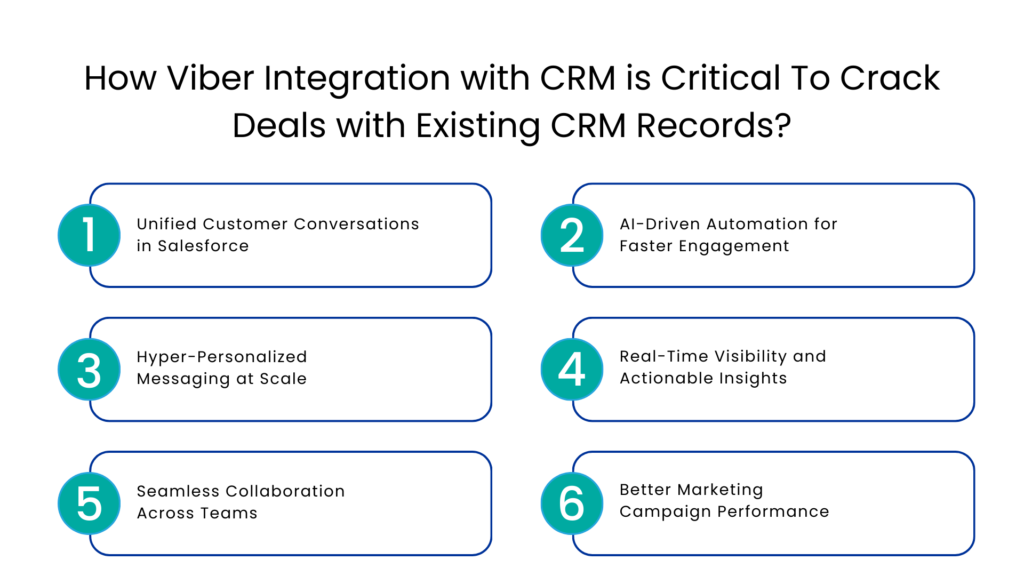
When businesses opt for Viber integration with CRM they are able to record every conversation within the CRM and have access to real time updates. This means that the business agents can draft smarter customer replies and the CRM allows them to automate routine tasks, leaving enough time for the sales reps to focus on high-priority activities.
Unified Customer Conversations in Salesforce
CRM Integration with Viber centralizes all customer interactions directly within Salesforce. This creates a single source of truth where sales, service, and marketing teams can access complete conversation histories without switching platforms or losing context.
AI-Driven Automation for Faster Engagement
Artificial intelligence automates routine tasks such as follow-ups, message routing, and response suggestions. This reduces manual effort, improves response times, and ensures customers receive timely and consistent communication at every stage of the journey.
Hyper-Personalized Messaging at Scale
By combining CRM data with real-time messaging, businesses can deliver personalized conversations based on customer history, preferences, and engagement patterns. AI enables this personalization even at scale, helping teams build stronger and more meaningful customer relationships.
Real-Time Visibility and Actionable Insights
All Viber conversations synced into Salesforce provide real-time visibility into customer engagement. Managers can track response times, interaction quality, and team performance, turning conversations into measurable insights and smarter decisions.
Seamless Collaboration Across Teams
Sales, support, and marketing teams work from the same conversation data inside Salesforce. This alignment ensures consistent messaging, smoother handoffs, and a unified customer experience across the entire lifecycle.
Built-In Compliance
Storing conversations within Salesforce ensures secure data handling, access controls, and complete audit trails. This makes it easier for organizations to meet compliance requirements while maintaining transparency and governance.
Future-Ready Customer Communication
As customer expectations and messaging volumes grow, Viber integration with CRM scales effortlessly. Businesses can handle higher interaction volumes without sacrificing personalization, quality, or operational efficiency.
Conclusion
Viber integration with CRM is a game changing solution for the business in modern times. By integrating Viber into CRM systems, companies reconnect their data with real human conversations. Passive records gain context. Idle leads gain momentum. Conversations turn into actions and actions turn into revenue.
Further, by centralizing messaging conversations and connecting them to CRM workflows, businesses replace fragmentation with clarity, context with continuity, and guesswork with actionable insight. The result is a CRM that doesn’t just store information, but actively supports timely engagement, stronger relationships, and more consistent deal progression.
FAQs
What is Viber integration with CRM?
Viber integration with CRM connects customer conversations from Viber directly into a CRM system. This allows businesses to store messages, track interactions, automate workflows, and respond to customers in real time from within the CRM instead of managing chats separately.
How does Viber integration turn passive CRM records into active deals?
By syncing live Viber conversations with CRM records, customer intent becomes visible immediately. Messages trigger updates, workflows, and follow-ups, enabling sales teams to act at the right moment. This transforms static contact records into dynamic deal-driving opportunities.
Why is Viber better than email or calls for customer engagement?
Viber offers faster, more personal, and asynchronous communication. Customers are more likely to ask questions, express urgency, or clarify objections via messaging than through emails or scheduled calls, making it a powerful channel for driving conversions.
Can Viber be integrated with Salesforce CRM?
Yes, Viber can be integrated with Salesforce to centralize conversations, automate responses, and provide real-time customer insights. This integration helps sales, support, and marketing teams work from a single source of truth.
Is Viber CRM integration scalable for growing businesses?
Yes. As message volumes increase, the integration scales without compromising response quality or personalization. Businesses can handle more conversations efficiently while maintaining strong customer relationships.
For more insights, updates, and expert tips, follow us on LinkedIn.