

Most businesses that use Telegram for sales or support think they’ve solved the problem once they set up a bot.
The bot replies, collects names, sends welcome messages, and other crucial notifications. Everyone nods, calls it integration, and moves on.
But here’s what the bot isn’t doing: it isn’t logging conversations into your CRM. It isn’t triggering follow-up workflows. It isn’t giving your sales manager visibility into what’s being discussed. It isn’t connecting Telegram activity to the rest of your customer data. It’s just responding automatically and silos are still there.
A Telegram bot without proper CRM integration isn’t a communication solution. It’s a very polished dead end.
The real work involves tracking leads, automating workflows, measuring performance, giving your team full customer context and that only happens when integration of Telegram with CRM is properly implemented.
This blog covers what this integration between salesforce and Telegram is all about and takes you through all the changes your business can witness after its proper implementation.
Why Telegram Is More Serious Than Most Businesses Treat It?
Telegram has crossed 1 billion monthly active users globally. It’s the dominant messaging platform in several markets across Eastern Europe, the Middle East, and Central Asia and it’s growing fast in B2B circles where privacy, speed, and group communication matter.
Leading businesses use it for customer support, community management, lead generation, and direct sales conversations. Teams use it internally for coordination. Prospects use it to ask questions they’d never type into a web form.
In other words, it is a place where real conversations, with real buyers, happen in real time. On a platform most CRMs still treat it as an afterthought.
The result is predictable. Telegram conversations happen. Leads ask questions, show intent, sometimes even ask for pricing. And then nothing. Because the conversation lived on Telegram and nowhere else. No CRM record. No follow-up trigger. No visibility for anyone who wasn’t in that specific chat.
That’s not a Telegram problem. It’s a connectivity problem. And its costing businesses more than they realise.
The Real Business Gaps That Act as Hurdles in Growth
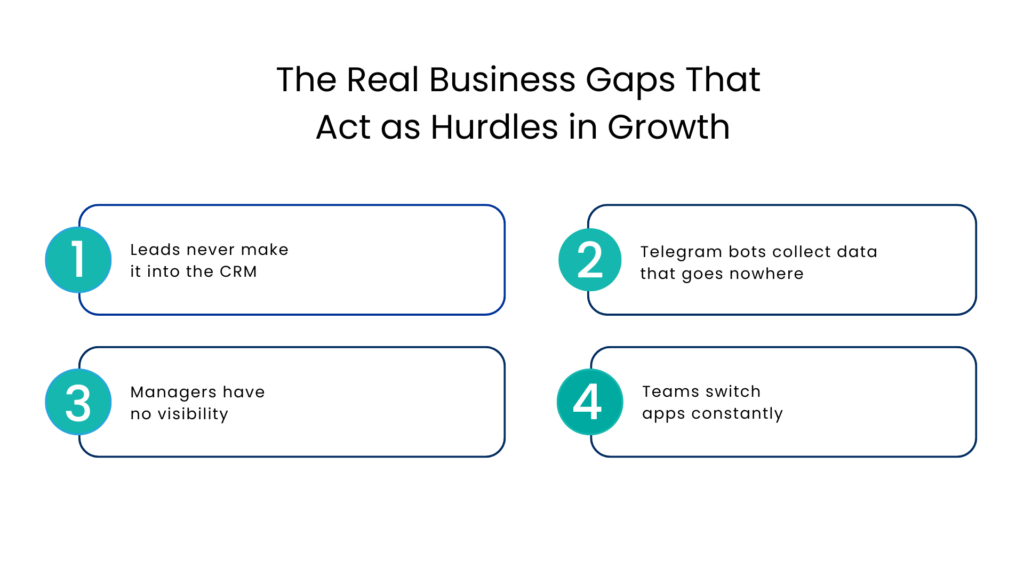
Let’s be specific about where things actually break down when Telegram Integration Platform is absent.
Leads never make it into the CRM
A prospect messages your Telegram channel with a clear buying signal. Your team responds. Good conversation. Then it ends and the lead exists only in Telegram. Unless someone manually copies it across to Salesforce, it’s gone. And manual copying, as every sales team knows, happens inconsistently at best.
Telegram bots collect data that goes nowhere
A well-built bot can gather names, contact details, even qualify leads with a series of questions. But if that data doesn’t flow directly into CRM records automatically, cleanly, without manual import it’s just sitting in a bot dashboard that nobody checks consistently.
Managers have no visibility
How many Telegram conversations happened this week? Which ones showed high intent? How fast did your team respond? Without CRM integration, these questions have no reliable answers. You’re managing a live sales channel completely blind.
Teams switch apps constantly
Your sales rep is in Salesforce, gets a Telegram notification, switches to the app, handles the conversation, switches back. Repeat all day. Every switch is a moment of lost context and a higher chance something doesn’t get logged.
What Proper Telegram CRM Integration Actually Looks Like?
Strip away the jargon and it comes down to this: Telegram should be a fully functioning sales channel inside your CRM and not a separate thing your team manages on the side.
Here’s what that means practically:
- Every conversation is logged automatically: A lead message on Telegram. It appears inside Salesforce, against the right contact record, with full conversation history visible. No manual entry. No imports. Just there.
- Full customer context during every conversation: Your sales rep opens a Telegram conversation and sees the lead’s full history, previous interactions, deal stage, what they’ve been sent before. They’re not starting from scratch every time. They’re continuing a relationship.
- AI across all channels equally: Suggested responses, conversation summaries, engagement tracking, working on Telegram the same way they work on every other channel. Not a separate tool. The same intelligence applied uniformly.
- One inbox for everything: Telegram, WhatsApp, Instagram, Intercom, SMS,all manageable from a single interface inside Salesforce. Your team stops switching apps and starts handling every conversation from one place with complete context.
This is exactly what Telegram CRM collaboration through Communicat-O delivers. It treats Telegram as a first-class channel, not an add-on. Built natively inside Salesforce so every conversation, workflow, and data point connects to the rest of your sales operation automatically.
If you want a deeper look at how Telegram specifically connects with CRM workflows, this breakdown of Telegram and CRM integration covers the full picture.
What Changes When Telegram Is Properly Connected with Salesforce?
The operational shift that comes with Telegram Bot Integration with CRM is immediate and measurable.
Sales reps stop losing context between conversations. They know exactly where each Telegram lead stands because the CRM knows. Managers stop flying blind on channel performance. They see Telegram data alongside email, WhatsApp, and everything else , in one dashboard, updated in real time.
Follow-ups that used to get dropped now happen automatically. Leads that used to disappear into a Telegram chat thread now have CRM records, scores, tasks, and sequences attached to them. The channel that was previously untracked becomes one of the most visible parts of your pipeline.
And the Telegram bot stops being a dead end. Bot-collected data flows directly into Salesforce. Leads qualified by the bot get scored, routed, and followed up on immediately. The bot does its job. The CRM takes it from there.
Businesses like Religare, Smart World, and Medica already run multi-channel stacks through Communicat-O because managing all channels from one place is the only setup that actually holds together at scale.
Conclusion
Telegram is not a casual channel anymore. For a growing number of businesses, it’s where serious conversations happen with real buyers, real intent, and real revenue on the line.
Treating it like a side platform that is managed separately, logged manually, measured almost never is how deals disappear without anyone knowing why.
Proper Telegram CRM integration changes that. Every conversation gets tracked. Every follow-up is triggered. Every lead connected to the pipeline where it belongs.
The boat was never the solution. It was always the starting point.
Want to see what a properly connected Telegram and Salesforce setup looks like? Book a demo with Communicat-O and stop treating your best conversations like they don’t exist.
FAQ
What is Telegram CRM integration?
It’s a direct connection between Telegram and your CRM. With this, conversations, lead data, and engagement history sync automatically into salesforce records, triggering workflows and giving your team full visibility without manual entry.
Isn’t a Telegram bot enough for business communication?
A bot handles automated responses well. But without CRM integration, bot-collected data stays in Telegram: it doesn’t update lead records, trigger follow-ups, or give managers any visibility. The bot and the CRM need to work together.
What other channels does Communicat-O support alongside Telegram?
WhatsApp, WhatsApp Calling, Facebook Messenger, Instagram, Intercom, Viber, SMS, LINE, WeChat, Zalo, and RCS;all manageable from a single unified inbox inside Salesforce.
Is Telegram CRM Integration Platform relevant for B2B businesses or mostly B2C?
Both. B2C businesses use Telegram for customer support and community management. B2B teams use it for direct sales conversations, prospect outreach, and deal discussion, all of which benefit from CRM connectivity equally.
For more insights, updates, and expert tips, follow us on LinkedIn.