

Businesses have relied on messaging for over 30 years now to manage customer communications, engage them with follow-ups, and make them feel valued. However, as the times changed, customers shifted towards visual appeals and interactions. Businesses understood the shift and slowly moved to RCS integration.
Sales teams have been utilising the Salesforce RCS integration to manage all customer communication in a unified inbox and keep detailed records of conversation history. But the real question lies elsewhere.
The question most companies still want to get an answer to is “Which among the Rich Communication Services (RCS) and Short Messaging Service (SMS) is a better opinion for sales and why?”
While the answer to this question lies ahead in this post, one key difference in both the services is that SMS is plain and simple, comes with a character limit, and is universally available. RCS on the other hand is more interactive, has an improved character limit. However, it is not universally available, and some telecom operators still do not support it.
Understanding RCS Integration CRM
RCS stands for Rich Communication Services and is an interactive messaging application. By using an RCS messaging CRM, the sales teams can achieve the following:
- They can maintain all the customer details, history, and records in a single Salesforce CRM without any extra integrations.
- Design visually appealing graphics within the CRM based on the product without using any third-party applications.
- Use interactive buttons like confirmation, carousels, and quick replies for faster lead generation.
- See read receipts, delivery status, and who is responding in real time. These real-time analytics are used for strategic business decisions.
- Send bulk messages to select lists or all the users at once without creating a manual broadcast list. All from within the CRM.
Understanding SMS Integration with Salesforce
SMS stands for Short Messaging Service. Unlike RCS it is a plain text based application used to keep the customers looped in the conversations. By using traditional messaging platforms, sales teams may achieve the following:
- Send a plain text message with links (if applicable) upto 160 characters from the CRM itself.
- Send out bulk messages to the users with agentic AI assistance to craft personalized messages.
- Higher delivery rates with 98% open rate and successfully delivered messages.
Key Difference Between an RCS CRM Solutions and SMS Solution
Before deep diving into which platform suits the best for sales teams, let us understand and delve into the key differences between the RCS and SMS platforms, and how the difference sets the two apart, even while being similar.
| Feature | RCS (Rich Communication Services) | Traditional SMS |
| Message Format | Supports rich media, images, videos, carousels, and interactive content | Plain text only (up to 160 characters per message) |
| Customer Interaction | Interactive buttons for replies, bookings, payments, and actions | Customers must type responses manually |
| Brand Visibility | Verified business profile with company name, logo, and branding | Displays only the sender’s phone number or short code |
| Media Sharability | Supports high-quality images, videos, PDFs, and product catalogs | Does not support media without switching to MMS |
| Read Receipts | Yes, businesses can see when messages are delivered and read | Generally not available |
| Typing Indicators | Shows when the customer is typing a response | Not supported |
| Call-to-Action Buttons | Built-in buttons such as Buy Now, Book Demo, or Call Sales | Not available |
| Personalization | Delivers personalized, interactive conversations using CRM data | Limited to personalized text messages |
| Internet Requirement | Requires an internet connection (mobile data or Wi-Fi) | Works over the cellular network without internet access |
| Device Compatibility | Supported on most modern Android devices and expanding across platforms | Supported on virtually all mobile phones |
| Customer Experience | Rich, app-like messaging experience within the default messaging app | Basic text-based communication |
| Best Use Cases | Sales conversations, product promotions, customer support, appointment booking, interactive campaigns | OTPs, alerts, reminders, delivery updates, and transactional notifications |
| Analytics | Detailed insights such as opens, reads, clicks, and engagement | Limited delivery reporting, depending on the provider |
| Salesforce Integration | Enables rich customer engagement, automated workflows, and personalized messaging within Salesforce | Primarily supports basic notifications and one-way or simple two-way messaging |
| Overall Engagement | Higher engagement through interactive and visually appealing conversations | Effective for simple, direct, and universal communication |
Top 6 Features Enabled with an RCS Messaging Platform
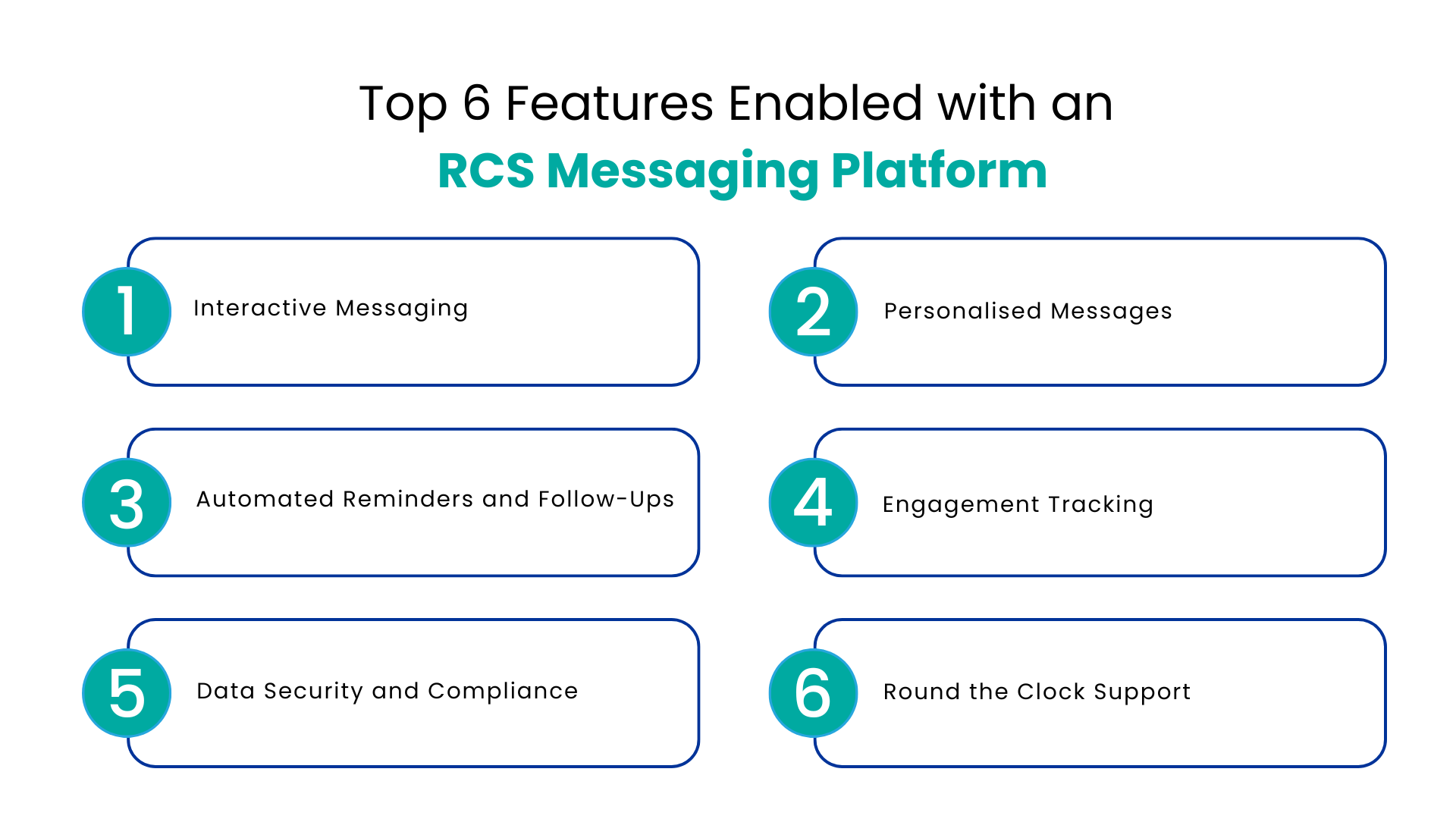
Having a well deployed RCS Salesforce CRM integration can do wonders for the business and if used correctly it can be a complete lead generation ecosystem. Here are the top 6 features of RCS and Salesforce messaging.
Interactive Messaging
By using RCS messaging within the Salesforce CRM, the sales reps do not have to sit for hours on a different application. They can create interactive messages by adding pictures, CTA buttons, and even forms – all within a unified conversation ecosystem. Moreover, the generative AI assistant helps in drafting beautiful messages which can also be saved as pre-defined templates for later use.
Personalised Messages
Since each customer is different from one another, it is only relevant for the businesses to send out messages that are tailored to suit the user needs. With the Salesforce CRM as a base for RCS messaging, the sales teams can draft personalized messages. The agentic AI systems read through the entire customer history and their past interactions, and based on the most recent thread, helps the agents draft the perfect message.
Automated Reminders and Follow-Ups
The sales teams can enable the automated reminder feature in the RCS integration system. This means that even if the sales rep forgets to follow-up on a particular lead or misses out on sending a message, the AI agents working behind the scenes will do so. They will trigger an automatic follow-up or reminder message, keeping the customer engaged and conversation alive.
Engagement Tracking
This is the most useful and the most important feature enabled with an RCS Salesforce platform. The real-time engagement metrics allow the teams and even the management to view the number of clicks made, how many users converted to potential leads and how many interacted. This analysis is deeply helpful to make strategic business decisions and refine messaging.
Data Security and Compliance
With every click made and every form filled, the company gets access to sensitive customer data. The CRM with RCS messaging ensures that the user data is encrypted with high security and at all levels. It ensures that every team has only the access they need and it is protected. This allows the organisations to be confident with their messaging and they are able to scale faster.
Round the Clock Support
Whether a user messages at 10 a.m in the morning or 11 p.m. at night. The integration offers 24*7, round the clock support, irrespective of time zone or location. Fully equipped with trained AI agents and functionalities, the system ensures that each query is answered at the same moment without delay. The agents receive the notification and they can easily follow-up the next morning without having to lose a lead.
When to Use RCS and When to Use SMS
Using RCS or SMS is a business choice that truly depends on the business goals, needs, and requirements. However, here is a breakdown on which cases require RCS and which can settle with SMS.
Use SMS When:
- The priority is reach. You need to reach all the phones, even those that don’t have access to data services (feature phones).
- You send transactional SMS, where reliability counts more than any fancy functions (One-Time Passwords, notification of appointments, alerts).
- You have a worldwide audience, and RCS functionality varies from region to region.
- You need to do things efficiently; you send a large number of low-cost notifications.
- You need guarantee of delivery without relying on data connectivity.
Use RCS When:
- Engagement is more important than reach. You need interactive and branded experiences
- Your audience uses mobile phones in regions with good RCS support
- Your marketing campaigns use rich media and interactivity for conversions
- Experience is what differentiates you. Your conversations should be modern and branded
- You are using conversational commerce with browsing, booking or buying in the message thread
Conclusion – Settling the RCS Vs. SMS Debate
Whether to use an RCS integration or a traditional SMS platform, is truly a business choice. Choosing the best among the two for sales teams can depend on business needs and goals. For businesses looking for a rich and interactive messaging experience and engagement, Rich Communication Services (RCS) is a preferred choice.
On the other hand, if a business wants to keep it simple and their only aim is to keep the conversation going and follow-up, they may opt for an SMS CRM integration.
So, in totality, the ultimate choice lies in the hands of the business themselves. While RCS makes the messaging experience interactive, SMS keeps it simple and to the point.
FAQs
What is the core difference between RCS and SMS for sales?
RCS offers rich messaging with images, buttons, read receipts, and branding vs SMS offers simple text messaging. It depends on the needs of sales and how you plan to engage customers.
Is there an opportunity for Salesforce to integrate with RCS and SMS messaging systems?
Yes. It is possible to integrate both SMS and RCS messaging systems within Salesforce.
When does business need RCS and not SMS?
If you need promotional messaging, personalized campaigns, appointment scheduling, and interactive messaging then you need RCS messaging. SMS works well for alerts, OTP, and reminders.
Is RCS messaging working on all mobile devices?
Not yet. RCS messaging is compatible with the vast majority of today’s mobile phones and supported by carrier networks, whereas SMS is compatible with virtually all mobile devices.
Which messaging system provides better analytics?
Although both RCS integration and SMS integration are effective real-time analysis tools, it will all depend on the system that your teams are using.
For more insights, updates, and expert tips, follow us on LinkedIn.