

Businesses in this competitive market can not afford to compromise with the ways they engage with their customers. If they fail to do so, they are not able to sustain for a long time. This is why the majority of them are utilizing platforms like Intercom to build meaningful connections with target audience as well as regular customers.
Real-time communication is preferred by users as it does not make them wait for answers. Immediate responses are received which builds trust. To make it possible, Intercom Integration with CRM is implemented by smart companies who want to be there for their customers every time.
Along with an improved customer engagement system, companies also achieve enhanced operational efficiency. The teams perform better, workflows become faster, and ROI gets higher, all with AI-powered Intercom CRM integration solutions.
By leveraging this integration, teams have access to one unified dashboard that replaces the need to use multiple platforms for dealing with customers. If your business is looking for a way to minimize inefficiencies in intercom communication, keep reading the blog.
Why Do Businesses Need to Integrate Intercom with CRM?
Brands that handle intercom conversations manually often face several operational challenges, especially when the data volume is large. Opening every message and typing a reply with full context becomes difficult for human agents. The problem of scattered data and unorganized workflows disturb the engagement. Responses are late, prone to errors, and generic which are not enough to impress the user.
To eradicate issues related to managing large data, a very large team is required to be hired so that agents can manually deal with the messages.
Also, when multiple tools are used, complete information is not available altogether. Time and again one needs to go through various sheets, mails, databases, and other tabs to gather context. This process takes a lot of time and makes the user wait for responses. Agents ask them to repeat their concerns which leads to frustration and decreased trust.
All such inefficiencies have a negative impact on customer experience as well brand reputation. Businesses that integrate Intercom with CRM strategically vanish these problems from their workflows by achieving a single dashboard where every conversation, customer detail, and history are accumulated in an organized manner. With this, responses become fast, context becomes clear, and connections become stronger.
How Intercom Integration CRM Works?
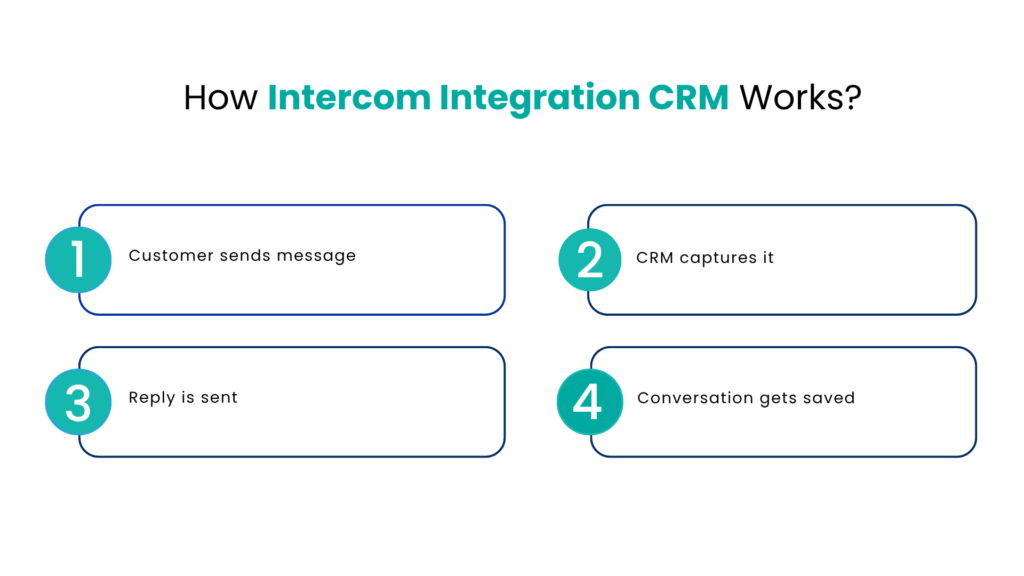
Intercom CRM integration starts working the moment a message is sent by a user. Either it is a normal message, query, or inquiry, everything is handled from salesforce itself. Here is the step-by-step flow:
Customer sends message
Whenever a user needs to know about something, have an issue, or a complaint, a message is sent from the intercom with an expectation of instant & relevant response.
CRM captures it
The company’s CRM system is linked with intercom, the message is instantly captured and is visible on the centralized dashboard.
If the message is sent by a new user, a fresh profile is created and all the conversations are saved under it.
Reply is sent
If the message is sent by a regular customer, all past interactions, preferences, and details are displayed in one place for context. The repetitive questions and common issues are handled by salesforce chatbots and when the query is complex, human agents seamlessly take over the conversation. They have full visibility in all the user history, so they offer personalized communication without asking the same questions again and again.
Conversation gets saved
CRM saves the conversation instantly under the user profile using real-time syncing feature. All the chats happening in future are also updated automatically without any manual effort.
All teams can access those updated records for a more streamlined and enhanced operational efficiency.
Key Features of Intercom Messaging CRM Solution
Centralized dashboard for all conversations
All the intercom conversations appear in the same unified dashboard attached with user profiles. This makes understanding the context easier for all team members to empower them to provide better solutions.
Automated replies and chatbot support
Automation and chatbot features that come from omnichannel CRM with Intercom enable instant responses to customer queries. They handle repetitive questions efficiently and ensure that no message goes unanswered, improving response speed and customer satisfaction.
Real-time customer data access
Teams and managers can have an organized and instant view of real-time customer information that includes personal details, past interactions, and preferences, during the ongoing conversation. This makes them send quicker responses with full context and personalization.
Personalization capabilities
When all conversations are saved in one place along with user history, likes, preferences, and AI-powered future suggestions, tailored messages can be prepared according to that. This builds stronger connections with enhanced customer experience that aids in boosting ROI.
Challenges Without Intercom CRM Integration
- Intercom conversations remain scattered across multiple tools which leads to frustration among agents responsible for management.
- The chat history is not accessible easily. Multiple tools are required to get it.
- Speed is hampered due to regular switching between multiple windows.
- Agents respond without context and keep asking repetitive questions to the customer that creates dissatisfaction.
- Opening every chat and sending responses to a large number of users results in missed messages and delays.
- Operational inefficiencies due to errors created by manual workflows.
- High-potential leads might lose interest due to delay in responses.
- Team productivity is negatively impacted because of large workloads and lack of automation.
- Customers are not satisfied as their messages are ignored or answered late. Sometimes they never receive a reply and they do not come back to the brand in future.
Conclusion
In today’s world where technology is developing rapidly, companies need to provide prompt and targeted communication with customers who have increasingly high expectations. However, this may prove difficult due to manual operations and non-integrated systems that result in ineffective work processes.
The problems mentioned above are solved by using Intercom Integration CRM that brings conversations, customer information, and workflow processes to one single platform and facilitates automation and synchronization.
Implementing an Intercom messaging CRM solution helps establish better connections, boost efficiency and maintain competitiveness using the advanced messaging capabilities of the Intercom CRM system.
FAQs
Why do businesses need to integrate Intercom with CRM?
Businesses need this integration to eliminate scattered data, reduce manual work, and improve response speed while delivering more personalized customer interactions.
How does Intercom CRM integration improve customer communication?
It provides real-time data, full conversation history, and automation, enabling faster, more accurate, and personalized responses.
What role do human agents play after Intercom salesforce integration?
Agents handle complex queries with full visibility into customer history, allowing them to provide personalized responses without asking repeated questions.
What impact does Intercom CRM integration have on business performance?
It improves response time, enhances customer engagement, increases team productivity, and helps boost overall ROI.
How does this integration help in personalization?
It uses stored customer history, preferences, and past interactions to create tailored messages and improve customer experience.
For more insights, updates, and expert tips, follow us on LinkedIn.