

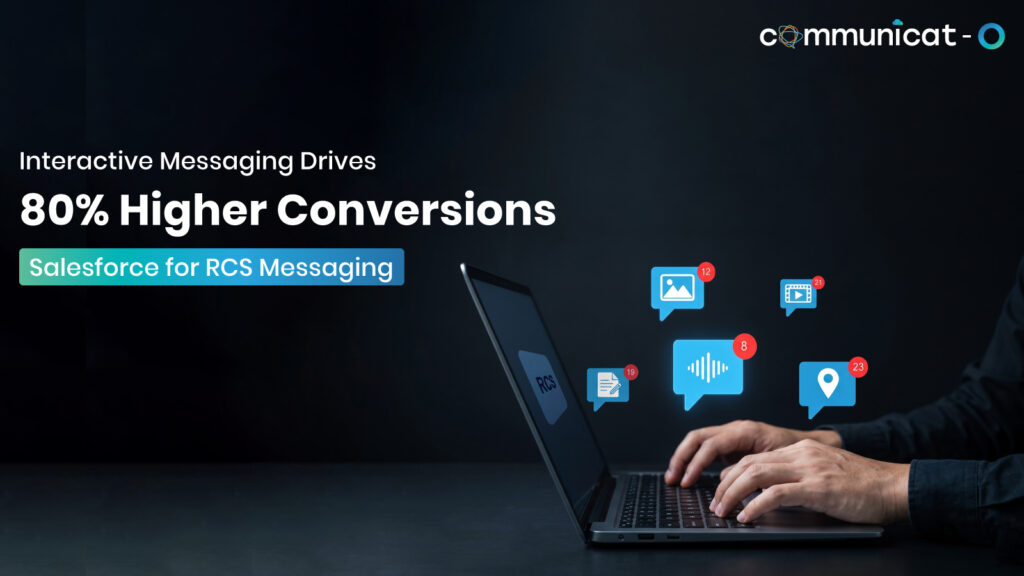
Text messages used to mean plain words on a small screen. That has changed. Rich Communication Services, or RCS, now lets a phone’s default messaging app carry images, buttons, and interactive cards, all without an extra download. For teams running customer communication through Salesforce, this shift raises a practical question: how do you pick an RCS CRM integration solution that actually uses this rich format well, instead of treating it like SMS with a new label?
This article skips the general introduction to RCS. Instead, it focuses on what a Salesforce-connected messaging setup should be able to do, what to check before you commit to a vendor, and where multimedia messaging tends to pay off fastest.
How Multimedia Changes What Salesforce RCS CRM Integration Solution Can Do
Once RCS is connected to Salesforce, a message stops being a single line of text pulled from a template. It becomes a small, interactive experience built from CRM data.
For example, a service rep can send an image showing a replacement part along with an update on the status of repairs. A salesperson can add a brief video about a product in a follow-up message. A support message can have two options, “confirm” and “reschedule,” rather than requiring a customer to reply.
It is important since the messaging behavior of customers has shifted in this way already. According to GSMA Intelligence, about 6 billion devices globally have become RCS-enabled, and they include both Android and Apple devices. Thus, the reach is large enough for rich messaging not to be a niche communication channel anymore.
The Capabilities Worth Prioritizing in an RCS CRM Integration
Not every RCS CRM integration solution on the market handles rich media the same way. Before choosing one, it helps to separate the features that are genuinely useful from the ones that sound good in a sales deck but rarely get used.
Here is a practical list to check against:
- Built-in rich media capabilities: Image, video, and attachment sharing needs to be handled natively by Salesforce.
- Buttons and Quick Reply: The user must be able to confirm, cancel, or take the required action by just a single click.
- Rich card and Carousel: These are required for communicating various products, properties or slots for appointments in the same message.
- Managing two-way messaging conversation: The replies need to be captured on the Salesforce platform, linked to the correct contact/case record.
- CRM fields personalization: Fields such as name, order status, appointment time and account history need to be auto populated.
- Message triggers: It would help if you had some trigger capability on the messages based on the activity on Salesforce such as Case status or Opportunity stage change.
- Delivery and Engagement Analytics: Insights on whether a message was delivered and read are required.
A Quick Comparison Table
| Capability | Why It Matters | What to Ask a Vendor |
| Rich media in native chat | Keeps agents inside Salesforce instead of switching tools | Can images and video attach directly from a record? |
| Buttons and carousels | Turns messages into actions, not just notifications | Are these built into the compose experience? |
| CRM-based personalization | Prevents generic, templated messages | Which Salesforce fields can populate automatically? |
| Automated journeys | Removes manual follow-up work | Can messages trigger from record or workflow changes? |
| Reporting and analytics | Shows what’s working and what isn’t | Is engagement data visible inside Salesforce, not a separate portal? |
If a vendor cannot answer the “what to ask” column with specifics, that’s a signal to keep evaluating.
Where Rich Messaging Creates the Most Value
Rich messaging is not equally useful everywhere. It tends to matter most in a few recurring situations.
Retail and Product Promotion
A retailer can send a short carousel showing three items from a customer’s browsing history, each with a quick “add to cart” style button. This replaces a generic promotional blast with something closer to a personal recommendation.
Financial Services Updates
A bank or lender can send a payment reminder with an account balance pulled from Salesforce, along with a button to pay directly or request an extension. This is more useful than a plain text nudge, and it keeps the customer inside one message thread rather than redirecting them to a portal.
Travel and Booking Confirmations
A travel agency may send an itinerary confirmation message that will feature an image of the accommodation, check-in instructions, and a button for making changes to the booking. The Rich Communication Services messaging standard protocol allows for implementing such functionality natively in the phone’s native messaging application.
Each of these examples shares a pattern: the message carries context from the CRM record, and the customer can act on it without leaving the conversation.
Building Personalized, CRM-Driven Customer Journeys
Personalization only works if the underlying data flow is solid. A Salesforce RCS integration should treat each message as part of a longer journey, not a one-off send.
That means:
1. Segment before sending: Segmenting based on Salesforce list view or campaign segment can be used to determine who will receive that particular message rather than blasting the entire contact database.
2. Stages of Journey: Decide what stages of your journey will feature rich media content instead of regular text-based one.
3. Define your fallback strategy: Not every mobile phone supports RCS technology yet. Good configuration will allow you to fallback to SMS in case of failure and make sure your message still reaches customers.
4. Keep it two-sided: Sending messages only in one direction isn’t the way to go with messaging. All your replies and button taps have to get into the appropriate Salesforce case or lead record.
This is where RCS Business Messaging differs from older broadcast channels. It is built for a back-and-forth exchange, not a one-directional announcement.
A Practical Checklist Before You Implement
It is better to go through a quick checklist before setting up a Salesforce-integrated RCS system rather than immediately doing vendor demos.
Data and Governance
- Ensure that the right Salesforce objects (Leads, Cases, Opportunities) will be used as triggers.
- Determine the owners of the message templates and workflows.
- Make sure the consent/opt-in statuses are managed appropriately.
Messaging Design
- Ensure each message contains only one card or carousel with one action.
- Do not overload any single message with multiple images and buttons.
- Test the message rendering experience on Android and iOS; the rendering can be different for both.
Measurement
- Have a baseline on delivery and read rates before doing any comparison.
- Track the button taps, not just opens; RCS is all about engagement!
- Analyze reporting data on a monthly basis; find where customers drop off in the journey.
Research by GSMA has shown that a majority of people are more likely to engage with a brand through a richer and more visual message.
Recommendations for Choosing an Integration Approach
There is no single “best” vendor for every business. But a few recommendations apply broadly:
- Prioritize native Salesforce embedding over bolt-on dashboards: If agents have to leave Salesforce to manage conversations, adoption suffers.
- Test the fallback path, not just the happy path: Ask how the system behaves when a customer’s device doesn’t support RCS.
- Look for AI-assisted qualification, but verify it’s optional: Automated responses can help with routine questions, but you should be able to turn them off for sensitive conversations.
- Confirm encryption and compliance details in writing: Don’t take security claims at face value during a sales call.
- Start with one use case, then expand: A single well-run journey, such as appointment reminders, teaches you more about vendor performance than a broad rollout across every department at once.
Conclusion
RCS CRM integration solution is most effective when it is tied directly to the information which makes it relevant – order history, case status, appointments, account activity. For instance, if you are currently relying only on plain SMS via Salesforce, perhaps now would be a good time to consider how an RCS solution that can deliver multimedia messages tied to your CRM will impact engagement with routine communications like reminder and confirmation texts. Test, measure, and then scale.
FAQs
Does RCS require customers to install an app?
No, since RCS works through the default messaging application on your phone if you use supported Android or Apple devices, so no additional installation is needed.
How does RCS differ from SMS when integrated with a CRM?
SMS can only include texts. An RCS CRM integration solution will be able to include pictures, buttons, carousels, and read receipts as well as personalize messages using the data stored in CRM.
What should happen if the customer uses a phone that doesn’t support RCS?
A well-thought-out RCS integration system should be able to switch to SMS seamlessly without affecting your communication process.
Is it possible to track responses to your RCS messages in Salesforce?
Yes, this is one of the necessary criteria that need to be met for RCS to work effectively. Responses, button clicks, and receipt statuses need to be reflected in the Salesforce records.
Is RCS messaging secure enough for use in finance or health care business?
RCS allows using encryption and verified profiles of senders, however, it is recommended to consult your integration provider regarding compliance issues such as GDPR.
For more insights, updates, and expert tips, follow us on LinkedIn.