

WhatsApp Calling CRM integration with Salesforce is transforming how businesses view customer engagement and how they connect with them in real-time. This AI-led integration gives the businesses a strategic advantage and allows them to connect using applications that customers are already using and trust.
However, this WhatsApp business calling CRM goes beyond simple integration. It is about how businesses stand out today and build customer relationships. Modern buyers expect immediate and hassle-free experiences which makes it necessary to bridge the gap between chat and call support.
With a WhatsApp call integration within Salesforce CRM, the businesses manage every call effortlessly and the customers are not stuck in a loop of inconsistency, irrelevancy, and repeat questionnaires.
In this insightful blog post, we explore 7 reasons as to why a Salesforce and WhatsApp calling integration is integral to businesses and how they use it to intensify customer satisfaction and experiences.
Why do Smart Businesses Need a Salesforce WhatsApp Calling CRM Integration Packed with AI Abilities?
While many businesses are already utilising WhatsApp calling, they are still not aware of how an AI-led Salesforce unified messaging and calling CRM is making this a smart tool for the business and the consumers alike.
By enabling this game changing omnichannel CRM integration with WhatsApp, agents can fetch calls easily and the AI-powered notifications make it difficult to skip a call. This essentially means:
- Businesses can make and receive calls seamless within Salesforce anywhere and anytime
- AI creates a smart summary of all calls saving time with long recordings
- Agents can easily convert these calls to real-time text making the searches and referrals easier
- Sales reps can transfer or even merge calls within Salesforce CRM platform
- Every call is recorded safely and can be listened to anytime
- You can put calls on hold and resume from the same point without losing context and without interruptions
7 Strong Reasons Businesses are Choosing Salesforce WhatsApp Calling
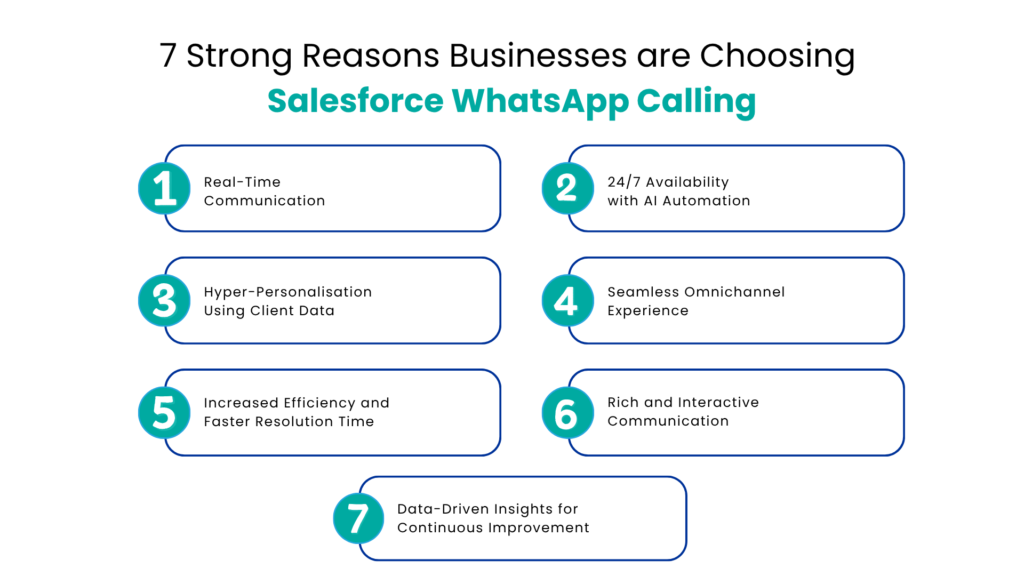
Having understood why businesses need a WhatsApp calling CRM integration, let us deep dive into the reasons why businesses choose this unified messaging and calling CRM.
Real-Time Communication
Time is the essence of any business and customers demand faster resolutions and quick responses. The Business calling feature in WhatsApp allows the agents to reach users faster, saving time on back and forth messaging. When this happens inside Salesforce, the sales reps can use generative AI assistants to reply smarter and close deals before the opportunity slips away.
24/7 Availability with AI Automation
Customer satisfaction remains one of the biggest drivers for business success. The AI-backed systems help in ensuring that the business is always on even outside of working hours. The voice AI can handle frequently asked questions, order tracking, appointment scheduling and basic troubleshooting. This 24/7 availability ensures no delays and with conversations recorded meticulously, the agents are always aware of the conversation context.
Hyper-Personalisation Using Client Data
Personalisation in the modern era of today is not optional but expected. With AI-led WhatsApp calling CRM – the customer data, past conversations, and behavioral insights are integrated in a centralized lead management system. This allows the businesses to address customers by name, refer past interactions, offer tailored recommendations, and provide context-aware support. This way the client experiences a seamless journey which is crucial to build loyalty and earn business trust.
Seamless Omnichannel Experience
Most businesses treat chats and calls differently. However, the WhatsApp calling CRM is an omnichannel platform combining chats, calls, media sharing, and customer data into a unified CRM. This allows for a fluid customer journey which means that when a customer sends a message they can easily switch to calling, and each aspect of the connection will be recorded wrestling in improved satisfaction. This ensures that no conversation is lost, duplicated, or mishandled.
Increased Efficiency and Faster Resolution Time
When AI handles most of the repetitive tasks like follow-ups, notifications, ticket creation, and data entry, the businesses automatically respond faster, resolve issues quicker, and can handle large amounts of queries. This reduces the chances of human error and operational delays. The companies using this solution report higher productivity and streamlined workflows.
Rich and Interactive Communication
Customer satisfaction is no longer just about speed but about visual appeal, clarity, and engagement. WhatsApp supports rich media like images, videos, PDFs, and voice notes, and the firms can leverage this to schedule visual product demos, share visual step-by-step guides, and instant document sharing. This makes the communication more interactive and easier to understand as compared to plain texts and emails.
Data-Driven Insights for Continuous Improvement
AI-led analytics is one of the most powerful features of the WhatsApp CRM. Every interaction including chat, call, and email is recorded and analysed to provide insights such as response time, customer satisfaction trends, frequently asked questions, and conversion rates. These insights help the businesses to identify bottlenecks, improve service quality, and optimise communication strategies.
The Bigger Picture – Why AI + WhatsApp Salesforce CRM Integration is the Future
The shift towards WhatsApp calling is not a trend but a strong response to the evolving customer needs. Where traditional CRM methods fail to deliver immediacy and personalisation, WhatsApp calling offers high engagement rates, familiar user interface, and instant accessibility. When combined with AI capabilities it becomes a complete customer engagement ecosystem and the businesses are able to anticipate needs, automate journeys, and deliver proactive support.
Concluding Thoughts
Today’s customer satisfaction is driven by three main elements: fast responses, personalized services, and convenience. With an AI-driven WhatsApp Calling CRM solution, all three elements come into play as well as efficiency, cost savings, and growth opportunities.
Businesses are turning to such technologies because it enables instant contact with customers, provides 24/7 support with the help of AI, and offers highly personalized customer interactions. In addition, it combines chat and calling into one system, reduces waiting time, boosts engagement by offering rich-media content, and helps identify improvement opportunities.
Given rising customer expectations, businesses have no choice but to adjust their approach and make sure they satisfy their customers’ needs and demands.
FAQs
Does WhatsApp have a Calling CRM?
Track interactions and calls coming from the whatsapp app and other channels in a single timeline within Salesforce. Communicate via instant messaging right within the WhatsApp Calling Salesforce CRM. Sales reps can send messages and use quick replies within whatsapp without switching tools.
Why do businesses use WhatsApp calling integration with Salesforce?
The integration of WhatsApp calling features in Salesforce allows users to make and take calls directly from customer relationship management records and logs them as an activity record for easier tracking during sales and service engagements.
What role does personalization play in WhatsApp calling CRM?
Personalisation in the Salesforce CRM allows the businesses to address customers by name, refer past interactions, offer tailored recommendations, and provide context-aware support. This way the client experiences a seamless journey which is crucial to build loyalty and earn business trust.
What is meant by an omnichannel experience in WhatsApp CRM?
WhatsApp calling CRM is an omnichannel platform combining chats, calls, media sharing, and customer data into a unified CRM. This allows for a fluid customer journey which means that when a customer sends a message they can easily switch to calling, and each aspect of the connection will be recorded wrestling in improved satisfaction.
How does WhatsApp calling CRM improve business efficiency?
It streamlines such tasks as follow-ups, alerts, and data input by automating them, making it possible to provide prompt replies, solve issues swiftly, and deal with more queries from customers.
For more insights, updates, and expert tips, follow us on LinkedIn.