

The customer engagement in the digitised world is no longer limited to emails or calls. They prefer quick calls, personalized responses and promotional offers that are relevant and not just a click bait hack. In this ever evolving world, CRM for WeChat and CTI have emerged as the most powerful tools.
Now, for businesses who want to expand and occupy a large market share, the question completely changes. It is not about if a CRM should be used, but about how to use it. Should they opt for a CRM system with WeChat automation and integration or get involved with a CTI Salesforce CRM for the long run.
This blog post will majorly explore the key differences between WeChat CRM software and CTI CRM solution, which is best for your business in terms of RoI generation and how you should plan the future strategies.
What is CRM for WeChat – A Detailed Overview?
WeChat is a messaging system and solution that is used globally by businesses to connect with their customers. It is a trusted platform by users due to its fast interface, interactive experience, and is compliant with government rules.
Now when this is combined with the Salesforce CRM, it becomes a powerful automated engine for growth. Combining every customer chat and conversation in a unified channel server, the businesses get real-time updates and can engage them better.
Key Features of WeChat CRM Solutions
- Customer interaction through official accounts and messages
- Generation of leads through QR codes and marketing campaigns
- Commerce and interactions via mini-programs
- Automated marketing and broadcast messaging
- Payment system integration
Most WeChat CRM applications operate in this environment by capturing and analyzing data from customer interactions.
Limitations of WeChat CRM for Business Organizations
Despite its numerous advantages, there are certain issues associated with WeChat CRM solutions:
- No central control over conversations of employees
- Difficulty in tracking customer interactions among departments
- Dependence on external CRM software for structuring data
- Possible problems with compliance and data management
Since employees usually interact with customers using their personal WeChat accounts, data fragmentation can occur.
Understanding CTI as a CRM Platform
Computer Telephony Integration, commonly abbreviated as CTI allows the businesses to make and receive calls directly from Salesforce CRM. This eliminates all manual functions and efforts of making a call as Salesforce does the job with the help of AI.
While most businesses prefer this functionality, it might have its own limitations like dependency on a stable network and connection, limited flexibility when scaling, and the risk of data security do run.
CTI CRM Key Functions
- Call logging and recording system built into the CRM
- Pop-up screens showing customer information on incoming calls
- Click-to-call capability directly through the CRM dashboard
- Smart call routing and interactive voice response
- Call monitoring and analysis in real time
- Customer data integration for tailored conversations
Core Differences Between WeChat CRM software and CTI
On one hand where WeChat is designed to support businesses, CTI on the other is built to redefine how a large enterprise functions.
Let us understand in simple language how these two platforms differ and how they contribute to the overall business RoI.
| Category | WeChat CRM Software | CTI (Computer Telephony Integration) |
| Purpose and Design | Built for messaging-based customer engagement and marketing | Built to integrate telephony systems with CRM for enterprise communication |
| Communication Channel | Chat-based (text, media, mini-programs) | Voice-based (calls, IVR, call routing) |
| Customer Interaction Model | One-to-many campaigns and conversational engagement | One-to-one structured voice interactions |
| Data Management | Often decentralized, may require external CRM integration | Centralized call data and customer records within CRM |
| Automation Capabilities | Marketing automation and broadcast messaging | Call automation, IVR flows, and intelligent routing |
| Integration Scope | Requires third-party tools for full CRM capabilities | Deep integration with CRM, helpdesk, and enterprise systems |
| Scalability | Suitable for small to mid-scale engagement | Designed for large-scale enterprise operations |
| Compliance and Control | Limited control over employee conversations | Strong governance with call recording and audit trails |
| ROI Contribution | Strong in customer acquisition and engagement | Strong in operational efficiency and service optimization |
Comparing WeChat API CRM RoI with CTI Business RoI
Talking about RoI, the comparison can be drawn with 5 major factors – Customer acquisition, conversion, customer retention, operational efficiency, and long-term scalability.
Let’s see how WeChat and CTI attain this RoI factor.
| ROI Factor | WeChat API CRM | CTI (Computer Telephony Integration) |
| Customer Acquisition ROI | Strong reach via QR codes, social sharing, and automated campaigns | Limited direct acquisition, mainly supports inbound/outbound call handling |
| Conversion ROI | Campaign-driven conversions with automation and moderate personalization | High conversion through real-time voice interaction and agent assistance |
| Customer Retention ROI | Automated engagement via broadcasts and campaign workflows | Strong retention via personalized call support and issue resolution |
| Operational Efficiency ROI | Automated data capture and campaign management, minimal manual effort | High efficiency with automated call routing, logging, and CRM integration |
| Long-Term Scalability ROI | Suitable for engagement-focused growth, moderate scalability | Highly scalable for large enterprises with complex call workflows |
Where Does Salesforce WeChat integration Fit in This Ecosystem
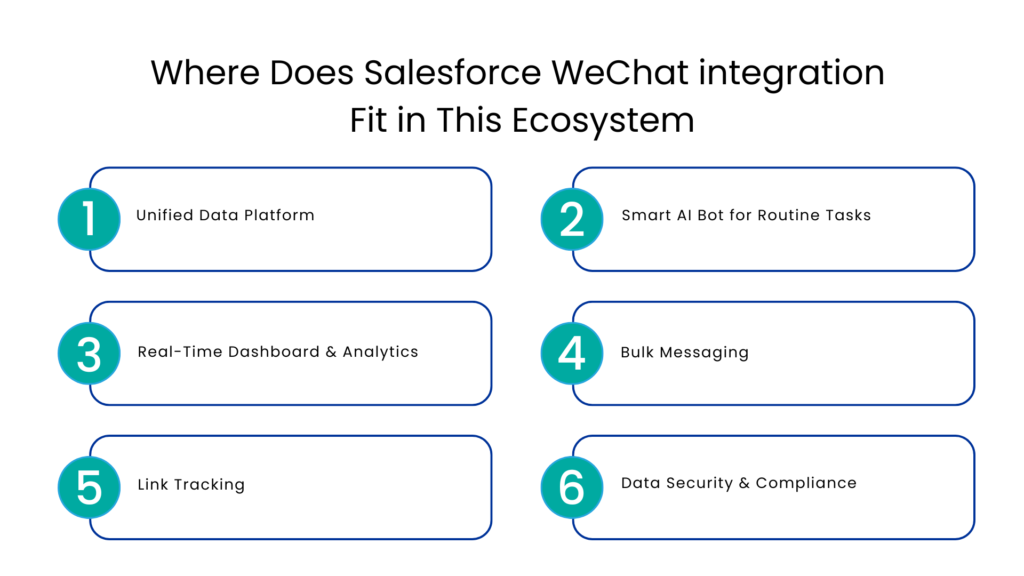
Once one understands the main differences between these two platforms, it is essential to know the part played by Salesforce integration within this concept. With this integration of Salesforce and WeChat, businesses will be enabled to automate their processes and run AI-based marketing campaigns that will increase sales and customer interactions.
Unified Data Platform
The essence of the Salesforce and WeChat integration is that it acts as a unified data channel for all the customers in the system.
Smart AI Bot for Routine Tasks
A trained AI bot combined with your currently used AI platform. It analyses each customer, their interaction history, and the past buying behaviour. Based on this real-time value proposition, it helps you draft the perfect response.
Real-Time Dashboard & Analytics
Provides your WeChat and AI enabled sales reps to study the customer graphs in real-time. From the most engaged part of the website to maximum drop off rate, it does it all and creates a dashboard. Agents and marketing departments use this data to send relevant and personalised campaigns.
Bulk Messaging
Allows each of your agents to send bulk messages from inside the Salesforce CRM. Agents and reps can use the AI system to craft responses and can also select the target audience inside Salesforce. This allows them to communicate with high-potential leads instantly leading to faster deal closures.
Link Tracking
With a CRM for WeChat, your sales reps and agents can easily track every link shared via messages. This is useful to agents and marketing departments as they get a direct and clear understanding of the user psychology and they can hit the right pain point of the consumer. This leads to personalised engagement and a more interactive marketing journey for users.
Data Security & Compliance
By enabling CRM analytics in WeChat, businesses ensure full data security and compliance with data regulation rules. This protects the sensitive data of the users, and the AI capabilities allow for a smooth fraud detection in an instant. This eventually builds trust in the customers and increases the company’s goodwill.
Conclusion
It may be tempting to think that there can only be one winner between CRM for WeChat and CTI when used by businesses. But that would not necessarily be the case.
While WeChat CRM offers unbeatable reach and customer acquisition possibilities, CTI on the other hand allows the businesses to handle their on-call customers with ease, while securely maintaining all data touchpoints. Additionally, when the customer query is resolved via a call, the personalised communication can be shared via WeChat for a better visual appeal and conversational approach.
The best strategy for maximizing ROI on the part of businesses would be a combination of both technologies, using WeChat for communication and CTI for control and then integrating all into one CRM system.
In the modern era of conversations, companies that succeed will not just do it by communicating faster but also by managing conversations better.
FAQs
How do you define WeChat API CRM?
WeChat is a messaging system and solution that is used globally by businesses to connect with their customers. It is a trusted platform by users due to its fast interface, interactive experience, and is compliant with government rules.
What is the main difference between CTI and WeChat?
While WeChat is a messaging-oriented platform for customer engagement and marketing, CTI is a telephony-based solution that combines phone-related capabilities and CRM to handle one-to-one interactions in a structured manner.
How Salesforce for WeChat helps with engaging customers?
WeChat’s CRM system allows for personalized messaging, automated management of campaigns, and monitoring of customer behavior such as clicking, thus enabling effective determination of customer intentions and customer engagement.
What are the key advantages that can be derived from integrating these two systems?
WeChat can help companies generate customers and engage with them using automated campaigns, whereas the use of CTI helps in handling calls efficiently, centralized database management, and better quality of service.
How could we optimize our return on investment through leveraging these two platforms?
Optimizing the ROI may be possible using WeChat for generating leads and communication purposes, while using CTI for handling customer calls and better conversion rate in a centralized customer relationship database.
For more insights, updates, and expert tips, follow us on LinkedIn.