

Speed is the key to customer trust. A prospect who fills out your web form at 10 AM and gets a call back at 3 PM has already spoken to a competitor. A customer who sends a support message on WhatsApp and receives a reply two days later does not stay a customer for long.
For small and medium-sized enterprises, this gap between customer expectation and operational reality is one of the most expensive problems hiding in plain sight. And it is not a staffing problem or a strategy problem. In most cases, it is a tooling problem.
CRM with WhatsApp integration for SMEs is closing that gap. By connecting the world’s most widely used messaging platform directly to your customer relationship management system, businesses are transforming how they respond, follow up, nurture, and close. The result is faster conversations, tighter sales workflows, and a measurably better customer experience.
This article walks through why this integration matters, how it works in practice, and what SMEs can realistically expect when they bring WhatsApp into the center of their CRM strategy.
Why Are SMEs Choosing WhatsApp as Their Primary Customer Channel?
WhatsApp is no longer an app used by consumers only. With its 2 billion-strong user base and open rates above 90%, it has become the best way to reach customers directly, regardless of the company size. Having WhatsApp as one’s communication tool helps to outshine bigger competitors.
Consumers use WhatsApp because it comes pre-installed on their phones, it does not require sign-up or downloading an app, and because it is convenient but non-intrusive. Being present on WhatsApp allows you to connect to customers where they already are.
The problem SME owners faced was that with WhatsApp, they were unable to communicate via CRM due to the inability to track customer history, manage communication processes in general, conduct analytics, and automate actions based on the conversation’s specifics.
CRM with WhatsApp integration for SMEs solves exactly that. Every conversation becomes part of the customer record. Every message is trackable, assignable, and auditable. And for the first time, WhatsApp becomes a channel your sales and support teams can actually manage at scale.
How WhatsApp Integration CRM Actually Improves Response Time?
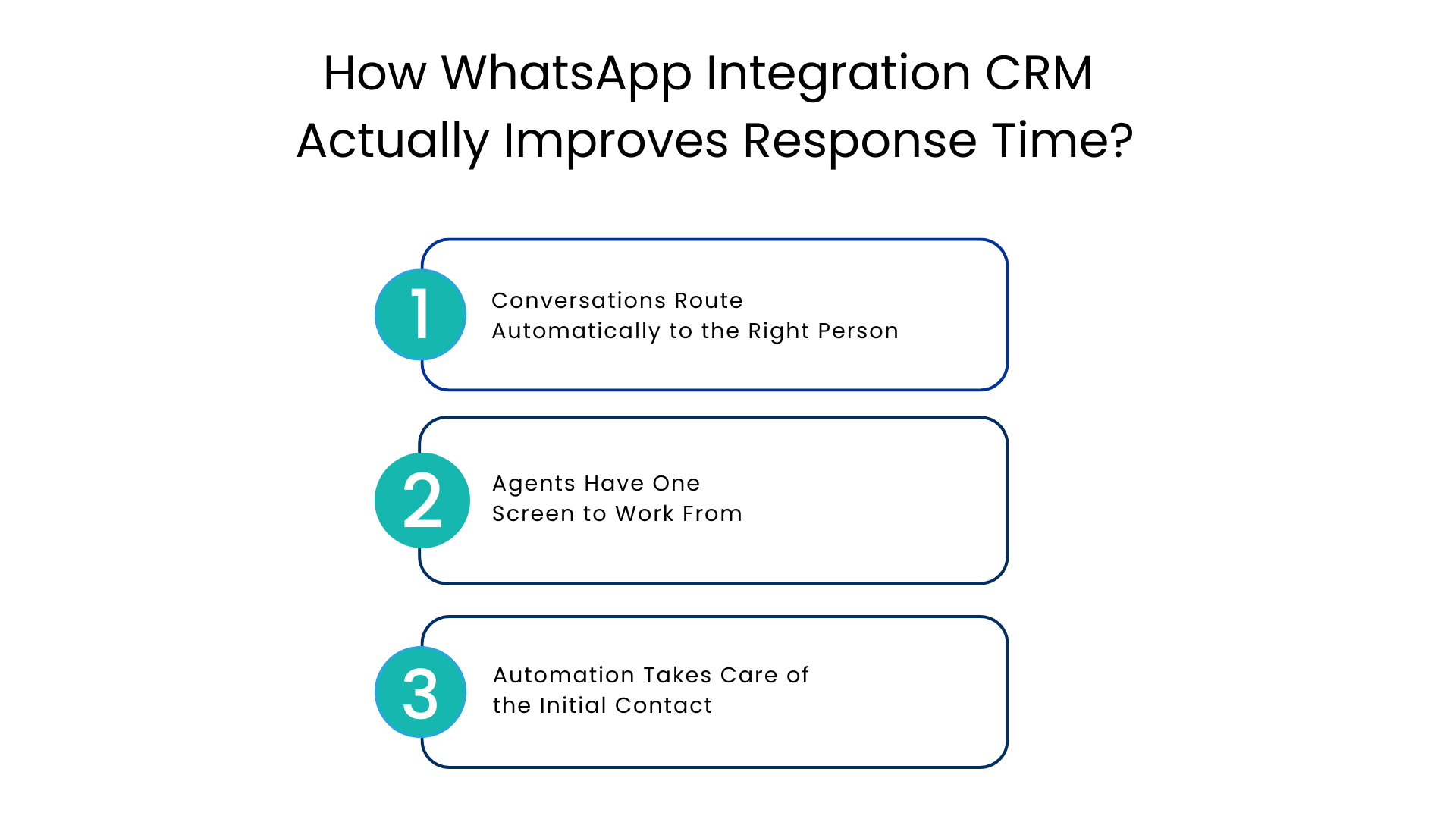
Response time is the most immediately visible metric that WhatsApp integration affects, and the mechanism is straightforward.
Conversations Route Automatically to the Right Person
Without integration, a WhatsApp message sent to your business number sits until someone picks up the phone. With a properly configured WhatsApp Integration CRM setup, incoming messages are automatically routed based on rules you define by region, by product line, by customer tier, or by the last agent who handled the account. The right person gets notified immediately; inside the tools they already use.
Agents Have One Screen to Work From
One of the subtle inefficiencies of non-integrated communication processes is that agents lose valuable time in switching between different sources of information and tools. An agent who has to look at WhatsApp through his smartphone, find the client’s record within his CRM, and then write his answer to the customer will lose two to three minutes in this process. Within the integrated process, he will be able to see the dialogue, client’s record, purchasing record, and open tickets on one screen.
Automation Takes Care of the Initial Contact
The use of automation does not mean that no human contact takes place. It only means that it is used to initiate a conversation. When you receive a message from the client late at night, the automated response helps set expectations, inform him that you received the request, and even clarify the customer’s needs. As a result, the agent can handle this case in the morning with ease.
The Conversion Case: How Conversational Messaging Drives Sales
The commercial argument for CRM with WhatsApp integration for SMEs is not just about efficiency. It is about conversion.
Higher Engagement Rates Translate Directly to More Opportunities
WhatsApp messages see open rates above 90% compared to email open rates that typically sit between 20% and 30%. When your follow-up sequences, promotions, and product recommendations land in a channel that people actually open, the math changes.
Comparison: Traditional Follow-Up Vs. WhatsApp CRM Follow-Up
| Metric | Email-Based Follow-Up | WhatsApp CRM Follow-Up |
| Average Open Rate | 20 to 30% | 85 to 98% |
| Average Response Rate | 2 to 5% | 35 to 45% |
| Time to First Response | Hours to days | Minutes |
| Conversation Context in CRM | Often manual | Automatic |
| Automation Capability | High (email sequences) | High (WhatsApp API flows) |
| Customer Preference (2025) | Declining for transactional | Increasing rapidly |
Personalized Automation at Scale
Perhaps one of the biggest benefits that comes from WhatsApp integration with your CRM system is automatic contextually personalized messaging. This means that after someone makes a purchase, he or she could receive a personal message welcoming him or her as an onboarding client. When a prospect visits your pricing page three times, he or she could receive a customized offer.
These messages will appear personalized because they will be contextual thanks to the information in your CRM database. They will be sent at a certain point due to behavioral triggers. Moreover, they will come through a channel that the customer uses to communicate.
Operational Advantages Beyond Sales and Support
The value of WhatsApp integration CRM extends beyond front-line teams. Operations, marketing, and leadership all benefit.
- For Operations: Automated appointment reminders, delivery notifications, and payment confirmations reduce inbound support volume significantly. Customers who know what to expect do not need to ask.
- For Marketing: WhatsApp campaigns based off of CRM segments do so at a fraction of the cost of customer acquisition. Re-engagement campaigns can be sent to inactive contacts, seasonal campaigns, or even just events, all with the customization capabilities of an email campaign and the response rate of enhanced SMS.
- For Leaders: With full conversation visibility, leaders have the ability to monitor the quality of response, look out for coaching moments, and monitor resolution times all from within the CRM.
The Role of AI and Automation in WhatsApp CRM Workflows
The most mature implementations of CRM with WhatsApp integration are not just connecting a messaging app to a database. They are building AI-powered customer engagement workflows that handle a significant portion of interactions without human involvement.
AI-powered messaging within a WhatsApp CRM context can handle:
- Lead qualification through conversational forms sent via WhatsApp
- FAQ resolution using knowledge base-connected chatbots
- Appointment scheduling with calendar integration
- Payment link delivery and transaction confirmation
- Escalation detection when sentiment signals frustration
Platforms like Communicat-O are built specifically to support these omnichannel engagement workflows, layering automation and AI on top of the WhatsApp Business API while keeping everything connected to your CRM data layer.
The result is a customer experience that feels responsive and human even during peak periods, outside business hours, and across multiple languages or regions.
What to Look for in a WhatsApp CRM Integration Platform?
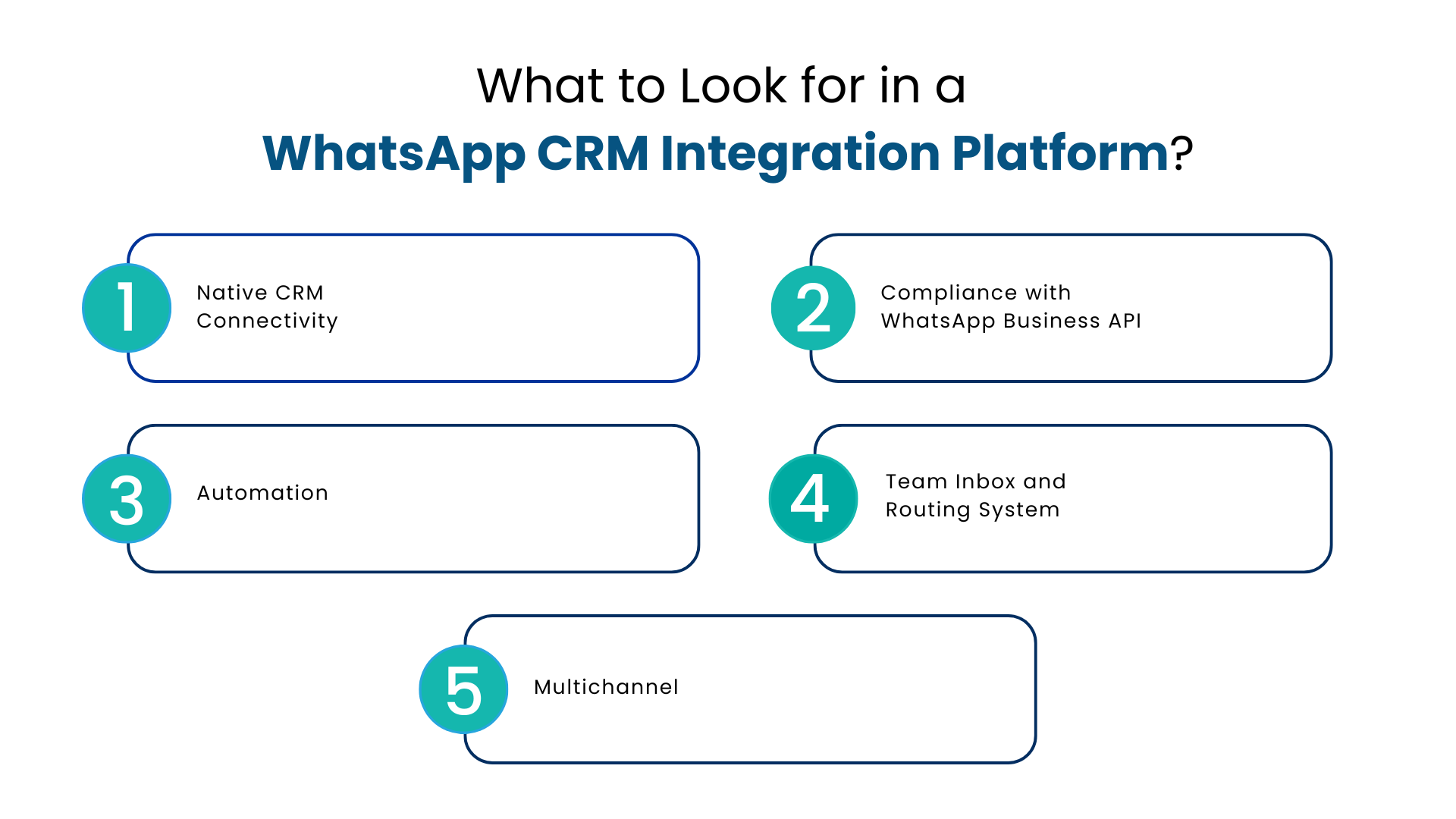
Not all integrations are built equally. SMEs evaluating their options should look for:
- Native CRM Connectivity: The integration should log conversations automatically without requiring manual exports or copy-paste workflows. If it does not write to your CRM records natively, it creates more work than it saves.
- Compliance with WhatsApp Business API: Every integration needs to comply with the WhatsApp Business API that Meta offers for higher volume, automatic and CRM-integrated messaging. Workarounds that rely on consumer accounts are explicitly against Meta’s Terms of Service.
- Automation: The ability to send messages via a trigger event in your CRM system is a necessity, not sending by hand.
- Team Inbox and Routing System: Your sales and support reps need a defined routing system to help them track conversations. An inbox that assigns tickets and allows for SLA compliance reporting is a basic requirement.
- Multichannel: WhatsApp would be only one element of an omnichannel strategy. The ideal scenario would have WhatsApp complemented by additional channels like SMS, Instagram, and Facebook Messenger.
Conclusion
For SMEs serious about customer experience in 2026 and beyond, CRM with WhatsApp integration for SMEs is no longer a nice-to-have. It is a foundational part of how modern customer communication works.
The businesses that respond fastest, follow up most consistently, and make their customers feel heard without friction are the ones that win. WhatsApp connected to your CRM gives you the infrastructure to do all three, at scale, without adding headcount.
Whether you are running Salesforce or another CRM, the principles are the same: bring the conversation into the platform, automate the routine, and free your team to focus on the conversations that require genuine human judgment.
If you are evaluating how to build this into your customer engagement stack, explore how Communicat-O’s Salesforce WhatsApp integration works, and book a demo to see the workflows in action.
The gap between how customers want to communicate and how most SMEs are set up to respond is closing. The question is whether you close it before your competitors do.
FAQs
What is CRM with WhatsApp integration for SMEs and how does it work?
When you integrate your customer relationship management software with WhatsApp, your CRM becomes integrated with the Business API of WhatsApp, which allows you to send, receive, and record WhatsApp communications inside your CRM.
How is Salesforce CRM WhatsApp integration different from manual WhatsApp use?
If you communicate with clients via WhatsApp without integrating it with your Salesforce CRM, this will happen without any traceability or automation. You will have all the conversations stored on your personal device, which won’t be visible to the entire team. However, if you use Salesforce CRM WhatsApp integration, the communication goes through Salesforce CRM automatically.
Does WhatsApp CRM integration require WhatsApp Business API?
Indeed, to get the most out of integrating WhatsApp into your business, you need to use its Business API, which is an official Meta solution. It should not be confused with consumer or unofficial ways of communicating via WhatsApp, as it violates Meta’s terms of service.
What kind of automation is possible with WhatsApp CRM integration?
SMEs can automate a wide range of workflows including lead qualification messages, appointment reminders, order and delivery notifications, post-purchase follow-up sequences, re-engagement campaigns for dormant contacts, and chatbot-driven FAQ resolution. All of these can be triggered by CRM events, meaning the right message goes to the right customer at the right moment without manual intervention.
How soon will an SME begin to see benefits from the integration of WhatsApp CRM?
The majority of SMEs have seen tangible improvements in their response times even in just the initial few weeks following the implementation, simply because the conversations have been auto-routed to an inbox view. The difference in sales conversion can be expected within a sales cycle or two, due to the compounded benefit of high open and response rates through WhatsApp.
For more insights, updates, and expert tips, follow us on LinkedIn.