


Imagine replying to a customer on time, following up accurately, and a few months down the line they have referred you as well. This happens due to a powerful WeChat integration. Because every initial interaction is automated, every follow-up goes through smoothly, and agents get real-time insights that help them interact with their customers in a better way.
On the other hand, when these conversations are managed outside a CRM, it leads to chaos. Leads are not reverted on time, and they eventually move to a competitor.
This article explores how the Hubspot WeChat integration helps with customer retention and why it is a game changer in the modern business era.
Why Does WeChat Belong in Your Global CRM Strategy?
WeChat is not a regional tool or a niche channel. It has over 100 million users outside its home market, with significant presence across the globe and they together account for around 20% of total WeChat users, and the platform has approximately 19 million daily active users in the US alone.
For global businesses, that footprint matters in a few very specific ways:
- International travelers and students carry WeChat with them and expect brands to meet them there
- Cross-border B2B relationships often run through WeChat, particularly in professional services, manufacturing, and logistics
- Hospitality, education, and retail brands serving international audiences find WeChat is already embedded in how their customers communicate
The Real Reason Retention Fails on WeChat
Most businesses that struggle with WeChat retention are not failing because of the platform. They are failing because of what happens, or what does not happen, after the conversation ends.
A customer interaction on WeChat that does not flow into a CRM is, from a retention standpoint, a conversation that never happened. There is no record. No trigger. No follow-up. No way to spot patterns across hundreds of similar interactions.
Here is a number worth sitting with: 68% of customers leave a business due to perceived indifference. Not bad products. Not better prices from a competitor. Indifference. The feeling that the brand simply does not remember them or care to.
That feeling is almost always a data problem in disguise. And WeChat CRM integration is how you solve it at scale.
When WeChat conversations sync into your CRM in real time, three things shift immediately:
- Every customer interaction becomes part of a searchable, actionable record
- Behavioral signals like browsing activity, questions asked, and purchases made become triggers for automated follow-up
- Your team stops starting every conversation from scratch and starts picking up where the last one left off
Companies using CRM tools see a 27% increase in customer retention on average. That number assumes the CRM is actually capturing your customer interactions. For businesses where WeChat is a primary channel, the integration is not optional. It is the prerequisite.
For Salesforce users, Communicat-O’s WeChat integration brings WeChat conversations, contact data, and behavioral signals directly into Salesforce, giving sales and support teams full context on every WeChat interaction without leaving their primary platform. The same approach applies when you integrate WeChat with Salesforce for marketing automation and customer journey workflows.
The technology exists and is ready to use. The question is whether businesses choose to connect it or leave the gap open.
The AI Layer: From Reactive to Predictive
The biggest shift happening in WeChat CRM workflows right now is not in the messaging itself. It is in what happens before the message is sent.
AI-driven personalization has been shown to lift customer retention by 10 to 15%, and 80% of enterprises plan to adopt AI for customer retention by 2026, according to Gartner. In the context of WeChat integration, AI operates at three distinct levels.
Predictive scoring: The CRM continuously analyzes WeChat engagement patterns including open rates, response times, Mini Program activity, and purchase frequency, then assigns each contact a churn risk score. High-risk contacts get flagged for proactive outreach before they show any obvious signal of leaving.
Intelligent routing: Incoming WeChat messages are automatically categorized and sent to the right person or team. Billing questions go to finance. Product queries go to the relevant product team. At-risk accounts surface immediately to account managers. No message sits in a generic inbox waiting for someone to decide where it belongs.
Content personalization: Rather than sending the same template to an entire segment, AI draws on CRM history to customize message content, timing, and offer for each individual. McKinsey found that companies mastering personalization are 71% more likely to see improved customer retention, and those that get it right generate 40% more revenue from support and marketing than those that do not.
AI does not replace human relationships. It makes the human relationship possible at a scale no team could realistically manage on their own.
Common Pitfalls and How to Overcome Them
Mistaking automation for personalization: Sending an automated WeChat message with someone’s first name is not personalization. Real personalization happens when the content, timing, and offer are shaped by that person’s actual behavior. That requires CRM data feeding the automation engine, not just a name field in a template.
Building flows without frequency controls: Over-messaging is one of the fastest ways to drive WeChat followers to unsubscribe. Build frequency caps and engagement-based suppression into every automated workflow. If a contact has already received a re-engagement message this month, they should not receive another one simply because they also appear in a lapsed-buyer segment.
Ignoring identity resolution: WeChat assigns each user a unique identifier per account they interact with. Without a deliberate approach to connecting those identifiers to your CRM contact records, usually via a phone verification step or a linked loyalty profile, you end up with fragmented data that does not represent the full customer relationship.
A 90-Day Roadmap to Get the Integration Working
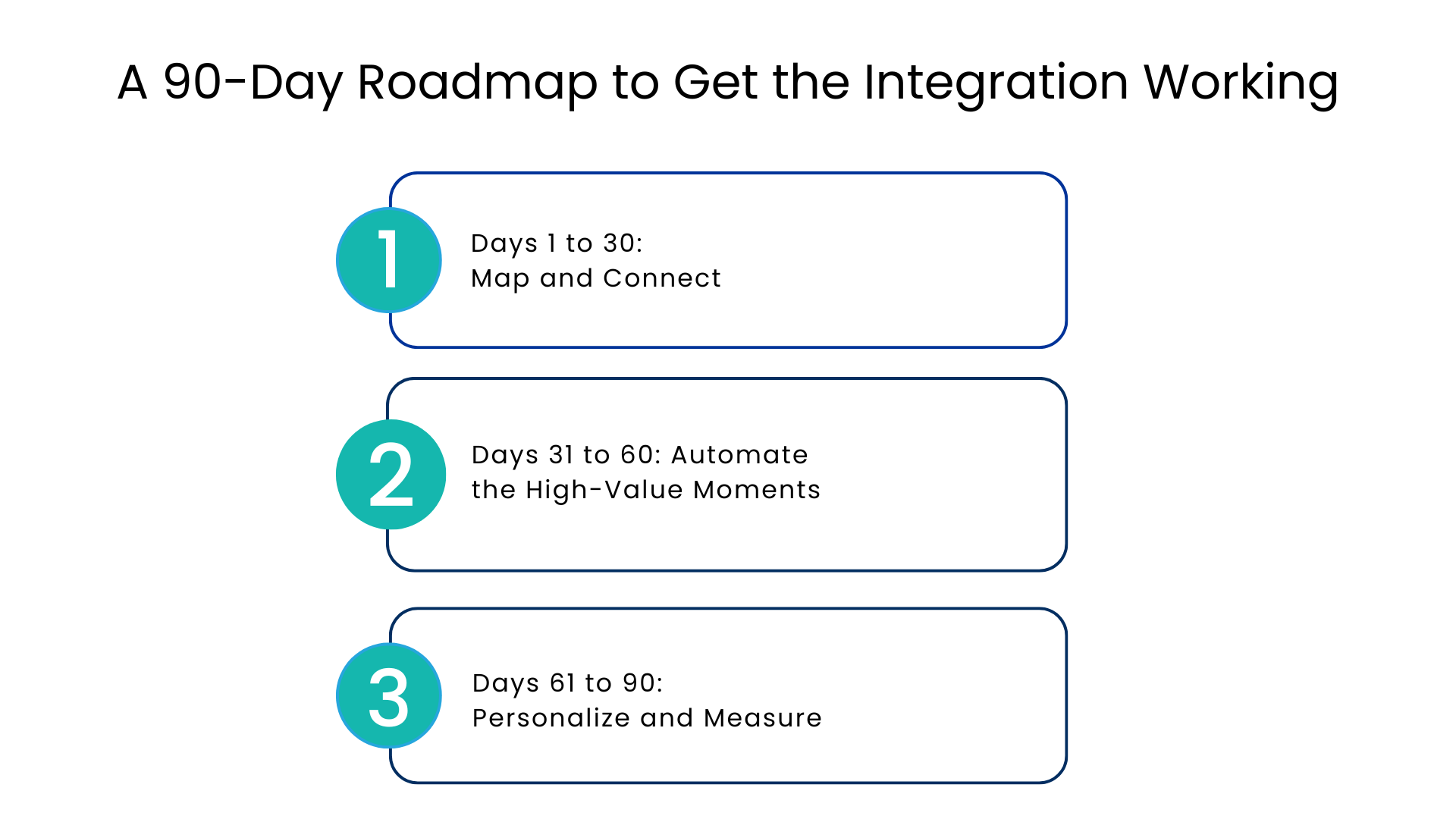
Days 1 to 30: Map and Connect
- Inventory every existing WeChat touchpoint across Official Accounts, Mini Programs, and WeCom
- Choose your integration layer: native API, connector tool, or custom build
- Set up bidirectional contact sync between WeChat and your CRM
- Define your churn-risk criteria and the behavioral signals that indicate a customer is drifting
Days 31 to 60: Automate the High-Value Moments
- Deploy a post-purchase WeChat sequence for new customers
- Set up CRM-triggered alerts for at-risk accounts
- Enable full WeChat conversation history visibility for support agents
- Implement frequency caps and consent flows across all automated messages
Days 61 to 90: Personalize and Measure
- Build behavioral segments using WeChat engagement data from your CRM
- Launch a personalized re-engagement campaign for your lapsed customer cohort
- Run A/B tests on message timing, content, and offer structure
- Configure attribution dashboards to accurately track WeChat-influenced retention
By day 90, your team should have meaningful context on every customer, your automation should be catching at-risk accounts before they leave, and you should have enough clean data to keep optimizing from a position of knowledge rather than guesswork.
Conclusion
Every strategy in this article comes back to the same idea: customers stay with brands that make them feel known. Brands can only make customers feel known if the data flowing through every customer interaction, including the ones happening on WeChat, is being captured, connected, and actually used.
The integration is not the strategy. It is what makes the strategy possible.
Whether you are building on a HubSpot WeChat integration or a Salesforce-based workflow, the infrastructure investment pays off exactly where it matters most: in the customers who do not just come back,but bring others with them.
Ready to connect WeChat to your CRM and build a retention system that actually works? Talk to the team at Communicat-O to explore what a tailored WeChat integration looks like for your business.
FAQs
What is a HubSpot WeChat integration?
A HubSpot WeChat integration connects WeChat’s messaging, Official Account, and Mini Program data into the CRM platform. It allows teams to manage WeChat conversations from inbox, sync contacts automatically, trigger automated workflows based on WeChat behavior, and measure WeChat’s impact on pipeline and retention, all from within the platform they already use every day.
How does WeChat CRM integration improve customer retention?
WeChat CRM integration eliminates the gap between where customers communicate and where customer data lives. When WeChat interactions sync to your CRM, your team gains full context on every conversation. Your automation can trigger proactive follow-up based on behavior. At-risk customers can be identified and reached before they disengage. All of that directly reduces churn in a way that reactive outreach simply cannot match.
Can WeChat be used by businesses that work outside Asia?
Yes, as WeChat already has more than 100 million users worldwide and there are active communities in Southeast Asia, North America, South Africa, and Europe. Many businesses that cater to diaspora communities, mobile students/travelers, or international B2B clients find that WeChat is the most popular communication platform among their clients despite the business location.
How do I know if I’m making any difference to retention with WeChat integration?
Measure these performance indicators pre- and post-integration: churn rate of WeChat users compared to non-users, second purchase rate for customers signed up to automated post-purchase marketing flows, first-touch resolution rate of WeChat-based customer support contacts, and re-engagement rate of dormant customer email campaigns. Establish UTM codes and pipeline tags right off the bat to ensure accuracy of your attribution analysis.
For more insights, updates, and expert tips, follow us on LinkedIn.