

Lets picture a common scenario, a potential customer is scrolling late at night and wants to inquire about some product. They send a message at 11:47 PM. Not an email. Not a form. A Messenger message because that’s what felt natural to them in that moment.
By 9 AM, when your support team logged in, two things had already happened. One, the customer had moved on.
Two, a competitor who had their Facebook Messenger CRM integration running had already responded, qualified the interest, and scheduled a follow-up.
That’s not a hypothetical. That’s a common thing happening.
Facebook Messenger has over 1.3 billion active users, and the expectation those users carry into every conversation is simple: fast answers.
Next-business-day answers are completely unacceptable by users because they do not have long attention spans these days. The only demand is a terrific combination of speed and accuracy
When a business integrates Salesforce Agentforce with Facebook Messenger through Communicat-O, you stop depending on office hours to run your customer experience.
An AI agent that knows your CRM, reads context, takes action, and only escalates when it genuinely has to. Here’s exactly how that works.
Why Is Facebook Messenger Still One of the Most Powerful Customer Communication Channels?
Nobody likes filling out forms. That’s not an opinion, it’s observable in every bounce rate on every contact page ever built.
Messenger is different. It’s a channel people already use daily, already trust, and already associate with getting quick responses.
The friction that kills lead capture on traditional channels; the fields, the waiting, the formality doesn’t exist here. Someone can ask your business a question the same way they’d text a friend.
What that means commercially: more inquiries, more conversations, more chances to convert. But only if you can respond at the speed the channel signals.
A Messenger message that waits hours for a reply doesn’t just go cold, it actively damages perception. Customers notice. And in markets where your competitors are one tap away on the same app, that noticeably slow response is a conversion handed to someone else.
For Salesforce-run businesses, Messenger has traditionally been a blind spot, conversations happening completely outside the CRM, no record, no follow-up structure, no visibility. Integrate Facebook Messenger with CRM properly and that changes entirely.
What Happens When Salesforce Agentforce Meets Facebook Messenger?
Customer sends a Messenger message → Communicat-O receives it and routes it into Salesforce → Agentforce pulls the customer’s CRM record, history, and any open cases → the AI reasons through the query using your live knowledge base and data → it responds, executes whatever action is needed for booking, case creation, or order update and escalates to a human only when the situation genuinely calls for it, with everything already loaded in context.
Agentforce understands what the customer is actually asking, even when they phrase it badly, even when they’re asking something you didn’t anticipate and it works from live CRM data, not a static script someone wrote six months ago.
That gap between reasoning and scripting is where the business value lives.
Those who Integrate Salesforce Agentforce with Facebook Messenger at the right time, with the help of reliable partners, and use it properly can provide desirable results to their regular as well as prospect customers which results in higher ROI.
9 Customer Service Tasks Your AI Agent Can Handle Automatically
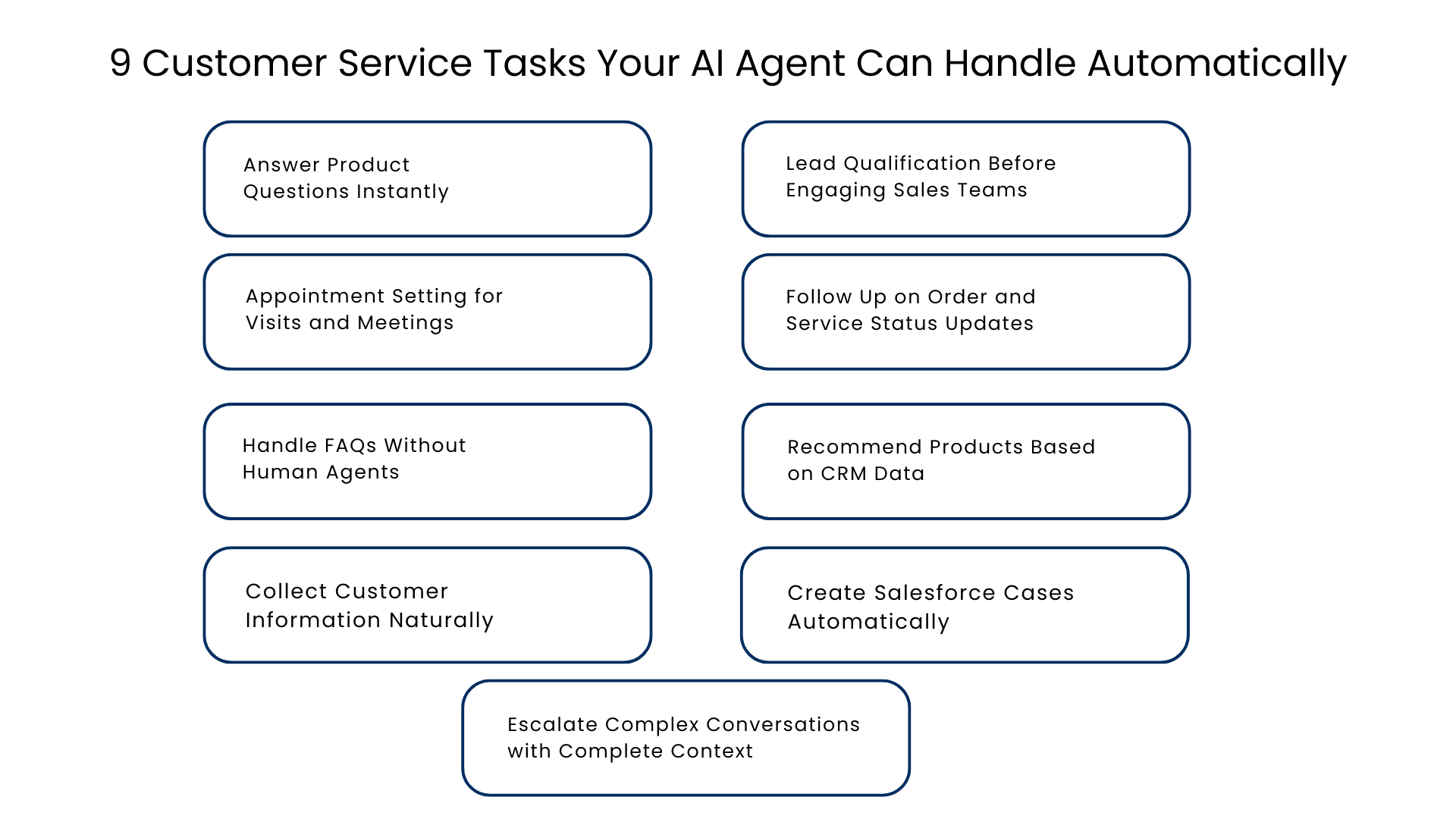
- Answer Product Questions Instantly: Accurate, contextual answers pulled from your knowledge base. No agent needed, no wait time.
- Lead Qualification Before Engaging Sales Teams: The AI scores and qualifies before the sales teams even begin communicating.
- Appointment Setting for Visits and Meetings: Availability is verified; an appointment is scheduled, right there in the Messenger thread.
- Follow Up on Order and Service Status Updates: Real-time order status comes straight from Salesforce. No calls needed on the customer’s end.
- Handle FAQs Without Human Agents: High-volume, repetitive queries handled at scale. Around the clock.
- Recommend Products Based on CRM Data: Purchase history, stated preferences, browsing behavior, all informing suggestions that actually fit.
- Collect Customer Information Naturally: CRM records updated through conversation. No form, no friction.
- Create Salesforce Cases Automatically: Every issue logged the moment it’s raised, with the full conversation attached.
- Escalate Complex Conversations with Complete Context: When a human takes over, they see everything. The customer repeats nothing.
Why Are Traditional Chatbots No Longer Enough?
| Traditional Chatbots | Agentforce AI |
| Scripted replies | Dynamic reasoning |
| Keyword matching | Understands intent |
| Static FAQs | CRM-aware responses |
| Limited automation | Executes business actions |
| No memory | Uses full customer history |
| Constant maintenance | Learns from Salesforce ecosystem |
Here’s the honest version of that table: traditional chatbots handle conversations you designed for. Agentforce handles conversations customers actually have, including the ones that go sideways, get specific, or ask something your FAQ page never covered.
That’s not a small difference. That’s the entire product.
Real Business Benefits of Connecting Salesforce Agentforce with Facebook Messenger
The outcomes aren’t abstract. They show up in numbers your team will actually report.
First response times drop from hours to minutes, sometimes seconds. Support costs fall because AI-powered Facebook Messenger CRM handles the tier-1 volume that was burning agent hours on questions with known answers.
Lead conversion goes up because qualification happens instantly, at the moment of intent, not the next morning. And customer satisfaction improves for a reason that’s easy to overlook consistency.
The AI gives the same accurate answer at 2 PM and 2 AM. It doesn’t have days off. It doesn’t accidentally contradict what a colleague told someone last week.
For sales teams specifically, the productivity shift is significant. Reps stop fielding the same pre-sales questions on repeat and start spending their time on conversations that are already qualified and ready to move.
The Industries That Get the Most Out of It
Some industries aren’t satisfied with getting the most out of AI-powered conversations, they are designed to do so.
Retail & e-commerce: Your customers expect answers before abandoning their cart. Status inquiries, returns, recommendations – all without any human involvement.
Real Estate: Any query can become your customer. Qualify leads, organize meetings, provide information exactly when their interest is peaking.
Healthcare: Customers shouldn’t have to be on hold forever. Appointment setting, filling intake forms and answering questions before they become frustrated.
Banking & Financial Services: High volume, high-stakes queries should not have long queues. Account queries, service issues and proper escalation procedures with no bottlenecks.
Travel & Hospitality: Plans change in an instant. Booking confirmations, live travel updates, disruption alerts all done in real time.
Education: Admission season is a busy one. Information about courses, status of applications, deadlines automated to keep your team focused on what really counts.
Why Businesses Choose Communicat-O for This Integration?
Most integration platforms sit between Salesforce and Messenger. Communicat-O sits inside Salesforce and that distinction matters more than it sounds.
There’s no middleware managing the data transfer. No third-party sync that breaks on a Saturday. No separate security model to audit. Because Communicat-O is Salesforce-native, the entire Facebook Messenger AI automation CRM layer operates within the same architecture your team already trusts with Salesforce’s own security, compliance, and data residency standards applied by default.
What businesses get beyond the architecture: certified implementation expertise, custom AI workflow configuration, defined escalation logic, omnichannel communication management, and optimization support after go-live. Not just a connection. A working system built for how your business actually operates.
Conclusion
Deciding to Integrate Salesforce Agentforce with Facebook Messenger isn’t a support upgrade. It’s a structural change in how your business handles customer communication, one that removes the dependency on office hours, eliminates the inconsistency of manual responses, and turns every Messenger inquiry into a managed, CRM-connected process.
The leads you’re losing to slow response aren’t gone because of price or product. They’re gone because someone else answered first. Always-on AI customer assistance, reasoning from real data, acting inside your existing Salesforce workflows is what changes that equation permanently.
Communicat-O builds that integration. The only remaining question is how many more Tuesday mornings you’re willing to start by catching up.
FAQs
What is Salesforce Agentforce Facebook Messenger integration?
It connects Salesforce’s AI agent platform, Agentforce, to Facebook Messenger, allowing it to receive, understand, and respond to customer conversations using live CRM data, knowledge bases, and automated Salesforce flows, through Communicat-O’s native integration layer.
How is Agentforce different from a regular Facebook Messenger chatbot?
Standard chatbots match keywords to scripted replies. Agentforce reasons through intent, retrieves live data, executes actions inside Salesforce, and handles conversations that don’t follow a predictable script without requiring constant manual updates.
Does this integration work with existing Salesforce records and data?
Yes. Communicat-O is Salesforce-native, so Agentforce has direct access to CRM records, open cases, knowledge articles, and automation flows, no external sync, no data leaving the Salesforce environment.
What happens when the AI can’t resolve a customer query?
Escalation rules are configured based on query type, sentiment, or customer profile. When a human agent takes over, they receive the complete Messenger conversation history and relevant CRM context, so the customer never has to explain the situation from the beginning.
For more insights, updates, and expert tips, follow us on LinkedIn.