

Most businesses have a customer communication problem they do not fully recognise. They respond to enquiries. They send promotions. They handle support tickets. But all of these conversations happen in isolation, without a thread connecting them back to the customer’s full history, preferences, and where they are in the buying journey.
For brands operating in South Korea or reaching Korean-speaking audiences globally, this problem is sharpened by one simple fact: your customers live on KakaoTalk. With over 47 million active users on a monthly basis in South Korea alone, KakaoTalk is more than just an instant messaging application. It is the default channel for daily communication, business interactions, and customer service.
If your CRM is not connected to KakaoTalk, you are managing customer relationships with a significant blind spot. KakaoTalk CRM integration changes that, and more importantly, it allows brands to automate the entire customer lifecycle from first contact to long-term retention, inside the channel customers already use.
KakaoTalk CRM Integration Explained
Here, we refer to a situation where messages exchanged through the KakaoTalk application are linked with your CRM system for customer engagement. Each message exchange, query, and auto-notifications become part of the customer journey that is recorded in the CRM system and linked with the right customer record.
This is unlike using a mobile application such as KakaoTalk to communicate with customers without integration. The team can send and receive messages but will not be able to learn anything meaningful from those messages. Enrichment is non-existent in this case since all that is left is to remember each message that is sent or received.
However, with a proper integration of the platform to your CRM system, everything changes. You will find a complete history of a customer’s interaction via KakaoTalk alongside the history of other interactions including emails, purchases, and queries raised. Your customer service team will have enough context to handle queries and you can set up automation rules based on message behavior.
For brands using Salesforce, a Salesforce KakaoTalk CRM setup means agents never leave the CRM to manage KakaoTalk conversations. Incoming messages appear directly in Salesforce, responses go out through the same interface, and every interaction is logged automatically without any manual data entry.
How KakaoTalk CRM Integration Automates the Customer Lifecycle?
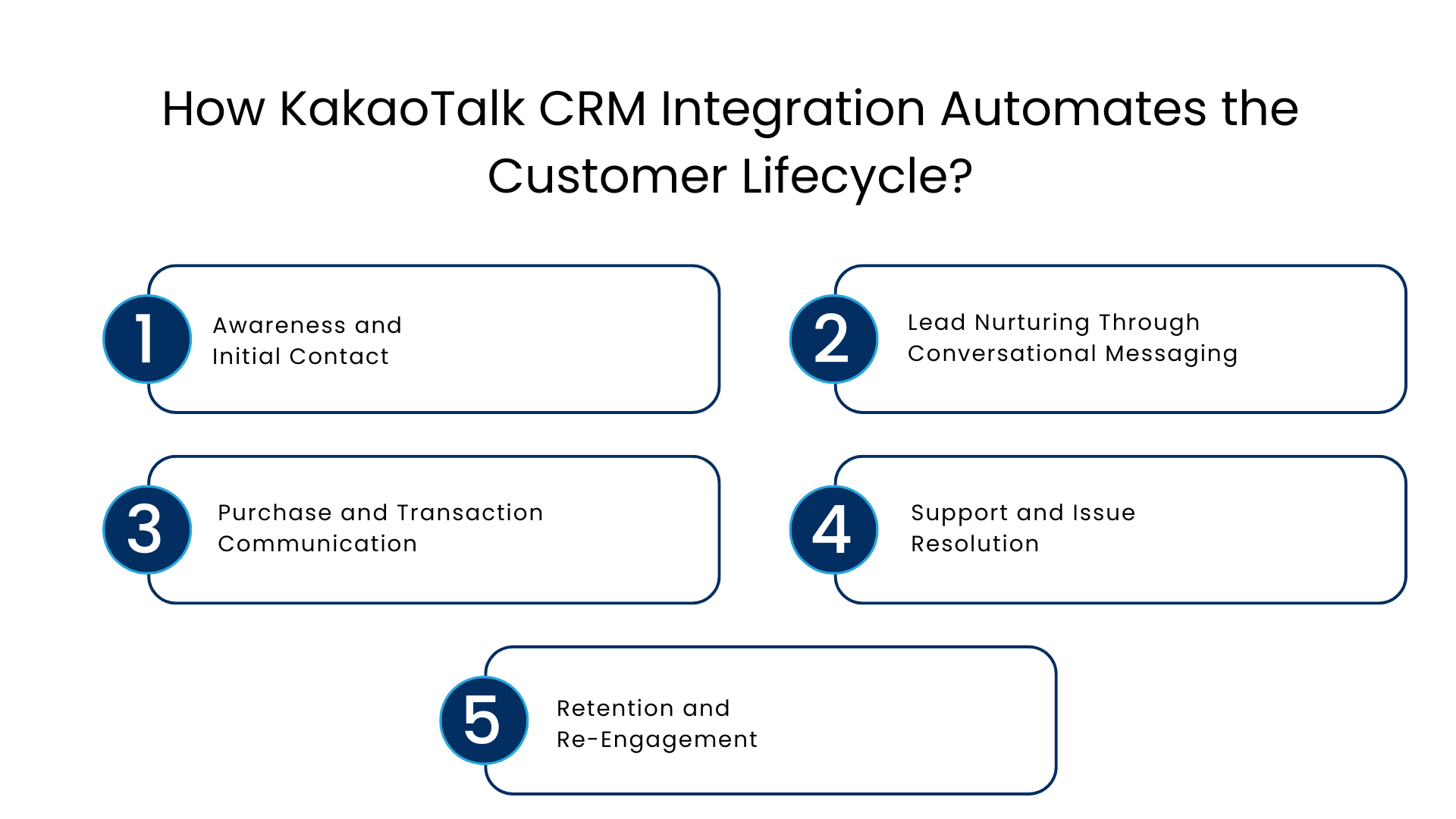
Customer lifecycle automation means different things at different stages. Here is how connecting KakaoTalk to your CRM supports each one.
Awareness and Initial Contact
Once a prospect initiates contact via KakaoTalk, their inquiry will automatically populate your CRM with either a new or an updated contact entry. There’s no need to transfer any information from one platform to another. The lead will be categorized based on its source and then redirected to the responsible department or automated.
This eliminates any lag time in responding to the initial inquiry. Timing is key at this point. The prospect who reaches out about your product and gets a tailored answer within minutes has a much higher chance of engaging further compared to those who receive a generic response after waiting several hours.
Lead Nurturing Through Conversational Messaging
Not every first contact is ready to buy. A connected messaging platform allows brands to run structured nurturing sequences through KakaoTalk, not just email. Based on CRM data such as lead score, product interest, or previous interactions, the system sends the right follow-up at the right time through a channel the prospect is actually monitoring.
This is where CRM-driven messaging creates a real advantage. A customer who downloaded a product brochure three days ago can receive a tailored KakaoTalk message offering a demo or answering their most common questions. The message feels personal because it is informed by real behaviour, not a broadcast calendar.
Purchase and Transaction Communication
Once a customer moves toward a purchase, KakaoTalk becomes a highly effective channel for transactional communication. Order confirmations, booking reminders, payment notifications, and shipping updates all benefit from the high open rates that messaging platforms deliver compared to email.
With CRM workflow automation, these messages trigger automatically based on order status changes or date-based rules. Your operations team does not send them manually. The system does, consistently, without gaps, every time.
Communicat-O’s omnichannel messaging platform makes it straightforward to build these automated message flows across KakaoTalk and other channels from a single Salesforce-connected interface.
Support and Issue Resolution
It is at the stage of support that most businesses end up losing their acquired customers. An angry customer who reaches out via KakaoTalk and waits for two days to be responded to has a low probability of retaining loyalty compared to one who gets a response within an hour.
The use of chatbots integrated into CRM software solves this challenge. For instance, a Kakao CRM chatbot can access customer orders and even solve some queries automatically without involving any live representative. The moment an agent needs to get involved in solving the challenge, they will receive all the information on the customer’s account before taking part in the discussion.
Retention and Re-Engagement
Customer lifecycle is not only about the purchase; retention needs continual contact that remains meaningful, relevant, yet nonintrusive.
Brands that integrate with the platform can send promotions regarding loyalty programs, personal reorder alerts, invitations, and feedback requests to customers via their chosen mode of communication when the time is right. Due to the fact that these communications are triggered by customer information in the CRM system, including purchases made, days since last contact, and loyalty program status, customers will find them more relevant than irrelevant mass communications.
Reengagement campaigns work in a similar manner. If a customer has not been active for 60 days, he or she can be reached with a personalized offer or simply an inquiry via KakaoTalk. This action would have been automatically triggered by the CRM system itself and not just by an employee manually sending some messages.
Why Salesforce Kakao Integration Matters for Enterprise Teams?
For larger organisations, the operational case for connecting Salesforce to KakaoTalk goes beyond convenience.
Enterprise teams managing hundreds or thousands of customer conversations per day cannot rely on manual processes to maintain quality and consistency. When KakaoTalk conversations are disconnected from the CRM, agents duplicate work, managers lack visibility, and compliance becomes difficult to demonstrate.
Salesforce Kakao integration solves these problems at the system level. All conversations are captured, attributed to the correct customer record, and visible to authorised team members regardless of which agent handled the interaction. Audit trails are complete. Handoffs between departments carry full context. Supervisors can monitor response quality and flag issues before they become complaints.
According to Salesforce research on customer engagement, companies that unify customer data across communication channels see measurable improvements in first-contact resolution and customer satisfaction scores. The business impact of meeting that expectation through a platform like KakaoTalk, where Korean consumers spend a significant portion of their daily communication time, is substantial.
Chatbot Automation in KakaoTalk CRM Workflows
The connection of chatbots in Kakao CRM needs particular mention because it is one of the top leveraged tools that companies can use in the context of customer communication through KakaoTalk.
First of all, a chatbot associated with your CRM does something that an ordinary process of interaction with customers cannot accomplish. It provides instant responses at any time of the day. It takes customer-related data from the CRM system to deliver personalized messages to them. It qualifies prospects through questions and updates the database according to the received answers. Lastly, it passes responsibility over to a live person when necessary.
The distinction between these two approaches is clear in terms of context availability. While an independent chatbot has knowledge only about the message typed by the client, a Kakao CRM system-integrated one knows about their purchase history, complaints, loyalty status, and service inquiries.
For brands managing high volumes of KakaoTalk messages, this automation layer reduces agent workload on routine queries by a significant margin, freeing the support team to focus on the conversations that actually require human expertise.
According to Gartner, organisations that implement conversational AI in their customer engagement workflows can handle significantly more interactions without proportional headcount increases, improving both cost efficiency and customer experience quality.
Conclusion
Customer lifecycle communication works best when it is consistent, timely, and informed by real data. KakaoTalk CRM integration makes all three possible for brands communicating with Korean audiences through the channel they actually prefer.
From the first enquiry to long-term retention, a Kakao CRM solution connects messaging to customer data in a way that removes manual effort, reduces delays, and creates personalised experiences at scale. For teams using Salesforce, this means staying inside the platform they already use, without switching tools or duplicating records.
The brands that will win on customer experience in markets where KakaoTalk dominates are the ones that treat it as a core part of their CRM strategy, not an afterthought.
FAQs
What is KakaoTalk CRM integration?
The KakaoTalk CRM integration makes sure that all activities carried out through the KakaoTalk application for business purposes are logged in your CRM account. It means that all the messages and conversations held through KakaoTalk will be automatically logged in your CRM, and the conversation will be linked to the profile of the respective customer so that none of the details have to be keyed in by hand.
How does KakaoTalk CRM integration automate the customer lifecycle?
It automates the customer lifecycle because this integration sends automatic messages to leads based on the customer data stored in the CRM, and it can send messages such as welcome and nurture messages once a lead comes into the picture; messages notifying about a completed transaction; chatbots that reply to questions from customers; and reengagement messages based on purchasing or inactivity.
How would a Salesforce KakaoTalk CRM work?
A Salesforce KakaoTalk CRM would allow agents to get KakaoTalk messages displayed in their CRM together with the entire customer profile. Agents can reply using the CRM without switching tools, and all interactions will be automatically recorded. The automations created in the Salesforce CRM could send KakaoTalk messages for various events, including a new customer case, the reaching of a certain lead score, and the completion of a sale.
What is the purpose of integrating a chatbot in Kakao CRM?
Integration of a chatbot in the Kakao CRM allows a company to connect its chatbot tool with its CRM tool, enabling the former to use customer data when replying to a KakaoTalk message. Unlike providing generic replies, the chatbot retrieves exact information on a customer (order or account details) and delivers customized responses. The bot automatically answers routine questions and sends complicated questions to a human agent along with the full history of the interaction.
What companies will gain the most by integrating KakaoTalk into their CRM systems?
Companies that communicate with people who speak Korean language or operate in regions where KakaoTalk messaging system is prevalent will gain. Examples include eCommerce stores, companies that deal in financial services, travel and tourism businesses, among others that conduct business in South Korea. Companies that use Salesforce CRM will especially benefit since integration maintains conversations within one interface without needing extra tools.
For more insights, updates, and expert tips, follow us on LinkedIn.