

Most marketing teams agree that keeping a customer is more valuable than acquiring a new one. Yet the tools they use to retain customers have not kept pace with how customers actually want to communicate. Email open rates continue to decline. SMS click-throughs are flattening. And the gap between what brands send and what customers actually engage with is widening every year.
This is not a messaging frequency problem. It is a messaging quality and context problem.
RCS Business Messaging is changing that equation. It brings rich media, interactive buttons, verified sender identities, and read receipts to the native messaging experience on Android devices. And when it is connected directly to your CRM data, it becomes a genuinely powerful retention channel rather than just another broadcast tool.
For teams already using Salesforce Marketing Cloud, the opportunity to integrate RCS in Salesforce marketing cloud and automation workflows can close the engagement gap that email and SMS alone cannot fill.
Why Has Customer Retention Become a Top Priority for Marketing Teams?
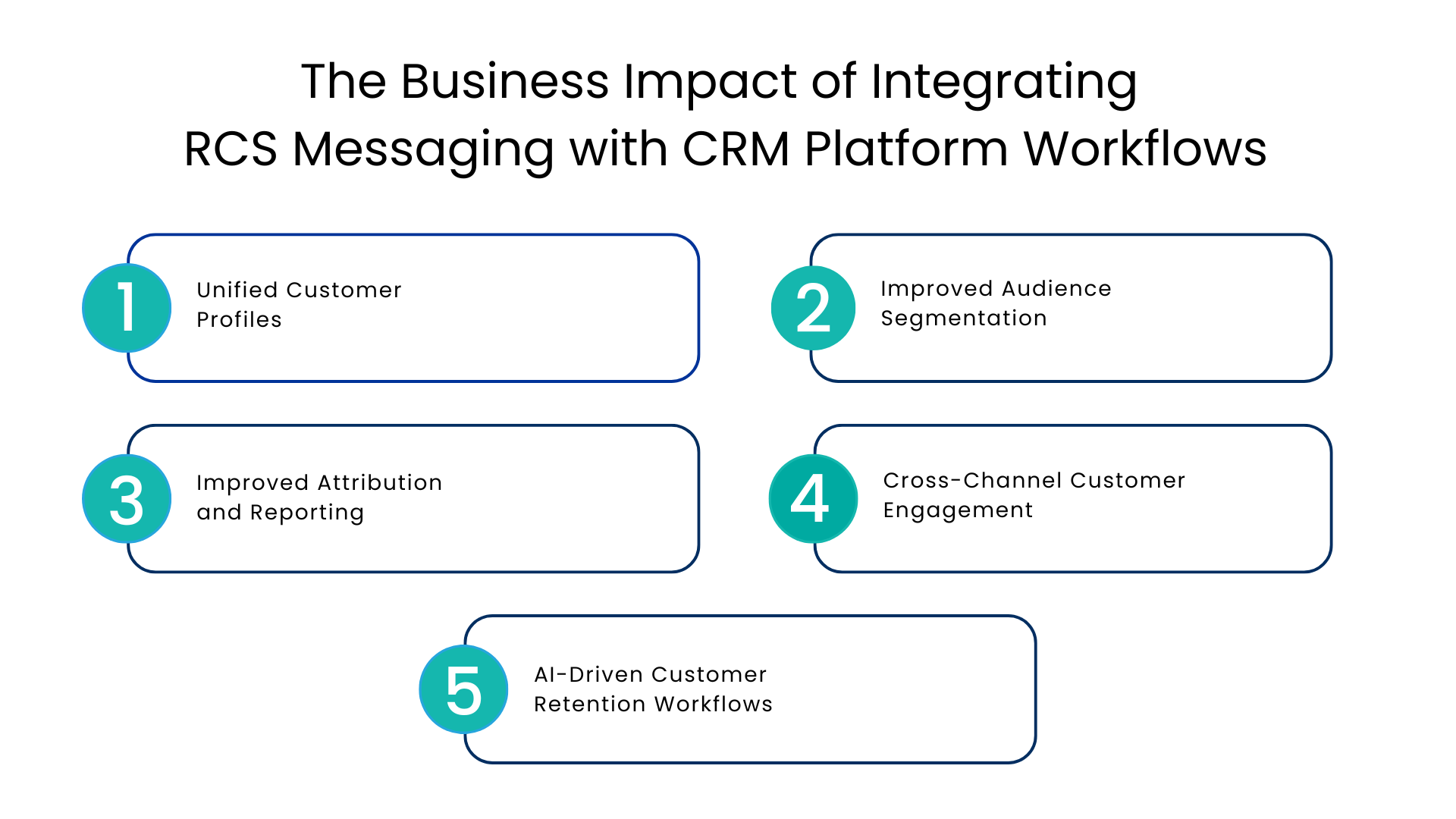
Increasing Cost of Customer Acquisition
There has been a steep rise in the cost of customer acquisition for almost all businesses over the last five years. The costs associated with paid search, social media and affiliate have gone up, and it is becoming increasingly difficult to acquire a customer compared to retaining one. In fact, the cost of acquiring a customer now ranges between five to seven times that of retaining one.
These numbers are compelling companies to reallocate their budgets towards customer lifecycle marketing, loyalty schemes and re-engagement programs. However, the technology used by businesses to implement these strategies is outdated and designed for customer acquisition. This disconnect leads to a retention gap.
Why Retention Increases Business Profits Over Time
It is much cheaper to retain customers, and the profit margins are higher as compared to acquiring new customers. A modest change in the rate of customer retention, say five percent, will lead to a significant increase in profits owing to low serving costs and pre-existing relationships with the client.
Customer loyalty also compounds. Long-term customers are more forgiving of service issues, more receptive to cross-sell and upsell offers, and more likely to engage with new products. But that loyalty has to be earned continuously, through relevant, timely, and genuinely useful communication.
The Limitations of Email and SMS Alone
Email inboxes are saturated. The average professional receives over 120 emails per day, and promotional messages compete with newsletters, transactional alerts, and internal communications. Even well-crafted campaigns see declining open rates.
SMS has better open rates but severe format limitations. Plain text with a URL is not the kind of interactive experience that drives meaningful customer engagement in 2026. And without delivery confirmation or read receipts tied to your CRM data, measuring campaign performance is guesswork.
Neither channel is broken. But neither is sufficient on its own for modern customer retention. They need a richer, more conversational layer alongside them.
How RCS Bridges Engagement Gaps
RCS Business Messaging delivers several things that SMS and email cannot combine in a single experience:
- Verified sender identity so customers know the message is genuinely from your brand
- Rich media support including images, carousels, and video thumbnails
- Interactive quick-reply to buttons and suggested actions within the message itself
- Read receipts and delivery reporting that feed back into your CRM analytics
- Native delivery through the Android Messages app without requiring a third-party app download
These capabilities make RCS a natural bridge between the reach of SMS and the richness of a mobile app experience. For retention specifically, that combination is significant.
How RCS in Salesforce Marketing Cloud Enhances Customer Retention?
Personalized Customer Journeys
With RCS in the Salesforce Marketing Cloud, marketers can send out highly personalized messages, which depend on real-time CRM information. A retail customer who viewed a product category without making a purchase could be sent a carousel of recommended products with just one click for adding to cart. A customer in the financial services space who needs a renewal soon could receive a summary card with information regarding his/her account and a call button to contact an advisor.
It is impossible to achieve such levels of personalization through text-based mediums. Furthermore, since the messages depend on the information stored in Salesforce, each one will reflect reality.
Interactive Message Experiences
Static messages communicate. Interactive messages connect. A carrier that uses RCS could deliver an interactive message for a flight with a check-in reminder containing an advance boarding pass, choice of seating, and an easy-to-use feature allowing users to change to business class.
These experiences eliminate friction points along the customer path and allow customers to easily complete the desired action through your marketing campaign.
Customer Re-Engagement Campaigns
Recovery campaigns are the highest return on investment activities within the field of customer lifecycle marketing. However, these are only effective when they penetrate through the clutter. Rich media win-back messaging with a personal offer, distinct brand identity, and one call to action beats simple text messaging hands down.
RCS allows marketers to create an experience which is much closer to one-on-one than mass communication.
Journey Builder Automation Opportunities
For Salesforce Marketing Cloud customers, Journey Builder allows for retention program automation. Incorporating RCS messaging into a Journey Builder workflow would enable businesses to:
- Send rich messages upon reaching certain milestones in a customer’s life cycle
- Establish a branched path for the journey depending on how an RCS message is engaged with or ignored by a customer
- Establish automated campaigns to progress from an RCS message to an email or even an agent
- Conduct an A/B test by sending different RCS messages vs SMS/email counterparts
The above-mentioned possibilities, enabled by automation, make programs more efficient.
Improved Campaign Performance Visibility
One of the persistent frustrations with SMS-based retention programs is limited reporting. RCS changes that. Because read receipts and interaction data flow back into Salesforce, marketers can see not just that a message was delivered but whether it was read, which button the customer tapped, and what happened next in the journey.
That kind of campaign attribution closes the loop between message performance and business outcome in a way that traditional SMS simply cannot.
The Business Impact of Integrating RCS Messaging with CRM Platform Workflows
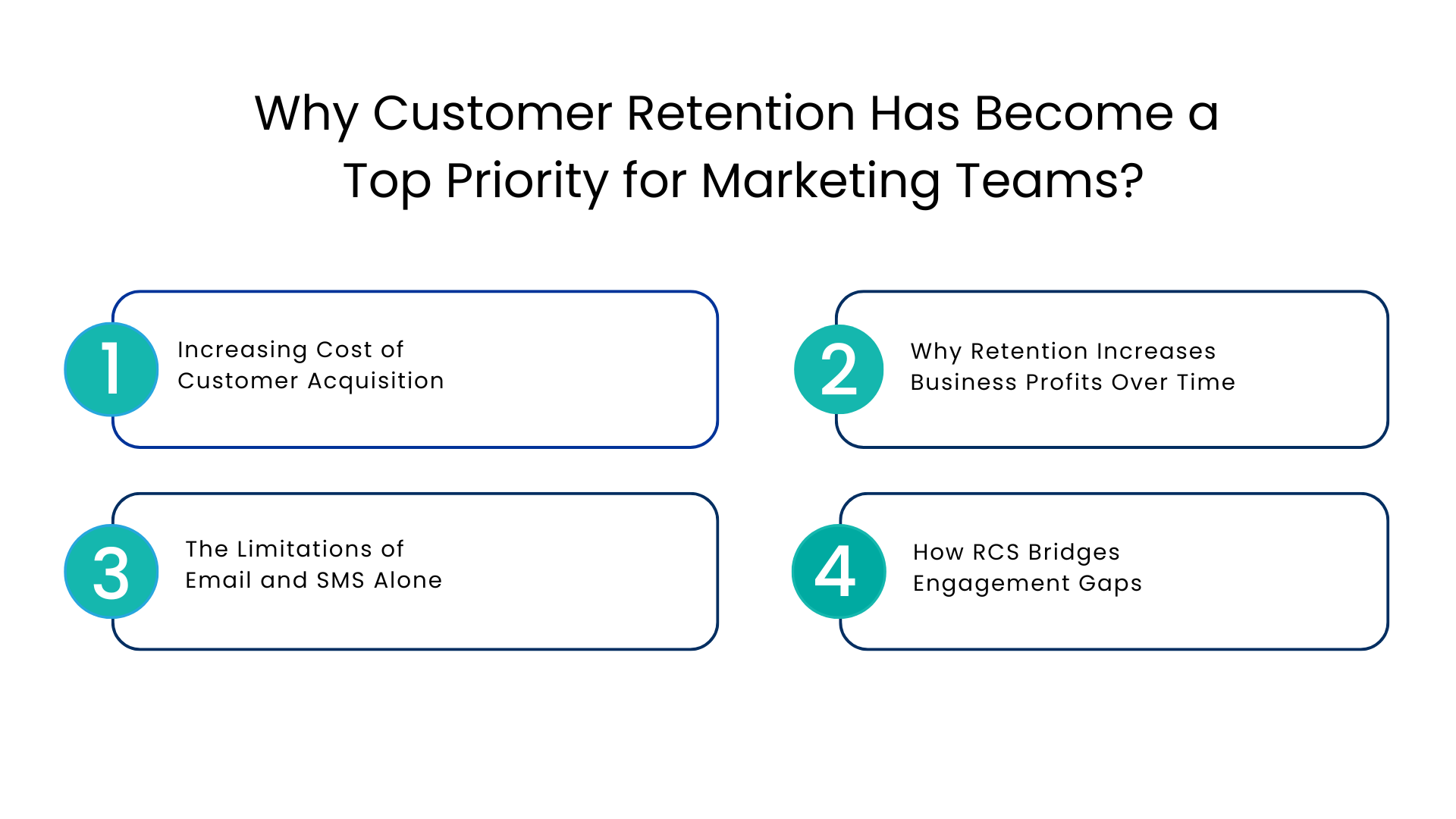
Integrating RCS messaging with CRM platform workflows is where the strategic value really compounds. The messaging channel alone is an improvement. The integration is what makes it transformational.
Unified Customer Profiles
Once the RCS communications are tracked against contact/account information on Salesforce, each customer interaction adds value to the customer profile. The support team knows what was sent out by marketing. The sales team sees how the customer responded. The entire history of conversations is kept within reach so that all stakeholders have context before reaching out to customers.
A unified customer profile is the cornerstone of customer experience consistency across channels.
Improved Audience Segmentation
Thanks to the availability of information about interactions between customers and businesses via RCS engagement, it is now easier to segment audiences. Customers who engaged with a carousel offer are placed into a high-intent category. Customers who were sent a message but ignored it can be funneled through a different channel for reengagement purposes.
Improved Attribution and Reporting
Channel investment should be proven with results by the marketing managers. The use of RCS messaging together with CRM platform data will enable teams to track how RCS messaging drives leads through the sales funnel, their conversions, and their impact on revenues.
Cross-Channel Customer Engagement
RCS works best as part of an omnichannel strategy rather than a standalone channel. In a well-designed retention program, RCS might handle the initial rich engagement, email handles the detailed follow-up, and a support agent handles escalations. When those channels share data through a central CRM, the customer experience across all of them feels coordinated rather than fragmented.
AI-Driven Customer Retention Workflows
Software such as Communicat-O introduces the concept of AI-driven automation in the RCS layer of Salesforce. The Agentic AI system can respond automatically to customers’ inquiries, escalate complicated conversations to appropriate agents, and recommend next actions to be taken for specific customers.
What Businesses Should Look for in RCS Messaging Integration Services?
Not all RCS integrations are built the same way. When evaluating RCS messaging integration services, enterprise marketing teams should look for:
Native Salesforce Integration
The integration should work from within Salesforce rather than connecting via a third-party middleware layer. Native architecture means faster data sync, fewer failure points, and easier administration.
Journey Builder Compatibility
RCS nodes should work natively inside Journey Builder, allowing teams to build, test, and optimize RCS-powered journeys without leaving their existing workflow environment.
Enterprise Compliance
Look for end-to-end encryption, GDPR-compliant data handling, and audit trails for all message interactions. In regulated industries like financial services and healthcare, compliance is not optional.
Analytics and Attribution
Integration would bring RCS delivery, reading, and interaction information right into Salesforce’s dashboards. Campaign attribution should be linked to CRM results rather than being contained in its own report-generating platform.
Scalable Omnichannel Capabilities
The best RCS CRM solutions are part of a broader multichannel platform. The Salesforce RCS integration from Communicat-O, for example, sits alongside WhatsApp, SMS, Telegram, Viber, and other channels in a unified interface, giving teams the flexibility to orchestrate cross-channel campaigns from a single platform.
Conclusion
Customer retention has never been more strategically significant, and the technologies for enabling this have never been better equipped. However, technology does not matter unless it works together. If an RCS message lives outside of your CRM system, it’s nothing but another type of mass broadcast. The same RCS message powered by Salesforce systems is an example of a valuable retention strategy.
This is precisely the reason why RCS in Salesforce Marketing Cloud represents much more than merely adding a new communication channel. On the contrary, it can be perceived as a strategic move towards managing customer relationships.
If you use email and SMS messages for building and maintaining your customer retention programs, then this is the right moment to analyze whether your strategy leaves anything on the table. What your customers prefer and whether you deliver on their expectations regarding interactive communication are two key questions here.
FAQs
What is different about RCS in Salesforce Marketing Cloud from an SMS campaign?
RCS in Salesforce Marketing Cloud allows for sending rich media through your messaging channel via the native Android messaging application. The main difference compared to the regular SMS campaign is the ability of RCS to provide read receipts and click data directly into the Salesforce CRM system.
What does it mean to integrate RCS messaging into the workflow of a CRM platform?
When integrating RCS messaging into the workflow of your CRM platform, you need to link your RCS messaging platform with Salesforce in such a way that messages are being sent according to the CRM data, messages’ responses recorded to each particular customer record, and campaign statistics provided.
In which industries would you recommend implementing omnichannel CRM powered by RCS?
Retail, financial services, telecoms, healthcare, and eCommerce benefit greatly from implementing omnichannel CRM powered by RCS messaging. Any other industry whose marketing is based on retaining and engaging customers through lifecycle communication could use this technology advantageously.
What should I be looking for when assessing the RCS CRM systems?
Make sure that you look for the Salesforce-native integrations, Journey Builder integrations, enterprise-level security and encryption, live analytics linked to the CRM results, and support for various messaging platforms apart from RCS. It is just as important how scalable and easy to manage the solution is compared to its feature set.
For more insights, updates, and expert tips, follow us on LinkedIn.