


There are some major changes when it comes to customer expectations. Customers no longer need you to place them on hold or even ask them to fill web forms for any kind of information. What they really need from you is simply to get back to them via the platform that they regularly use in a personalized manner.
This is why the way of communicating has also changed significantly and combining CRM software along with messaging platforms such as Viber has become an essential requirement for most companies. Viber CRM solution can help create a communication process that not only saves time but also leads to success.
Understanding the Viber CRM Solution
When we speak of a Viber CRM solution, we refer to a technology that seamlessly integrates the business messages of Viber with your CRM system. You don’t have to manage Viber messages using the app but conduct all communications through your CRM with access to customer history, contact details, and workflow automation.
What follows is that when a customer starts messaging through Viber, they are not only initiating a conversation, but a tracked interaction that can be connected with a specific contact record, stage of a deal, or customer case.
Understanding Conversational Commerce in Modern Business
Conversational commerce refers to the practice of conducting sales, marketing, and support through real-time messaging channels rather than static web pages or traditional email flows. Instead of pushing customers through a funnel, businesses engage them in two-way dialogue at the right moment.
Think of it this way: a customer browses a product, has a question, and instead of hunting for a contact form, they send a Viber message. The business responds in seconds, answers the question, and completes the sale in the same conversation. That is conversational commerce in action.
For it to work at scale, those conversations need to be tied to a system that tracks context, automates follow-ups, and gives teams visibility across all channels. That is where Viber CRM integration becomes essential.
How Viber and CRM Platforms Work Together
Connecting Viber to a CRM platform changes the mechanics of customer communication in several practical ways.
Centralized Customer Data
Every message that goes to and from Viber is automatically attached to the respective client profile within the CRM database. No more switching programs or searching through messages in different inboxes, because all communications via Viber, email, or any other channel – are now stored in one location.
This is particularly helpful when dealing with large numbers of clients, since the complete communication history can be easily accessed whenever needed, and your team won’t need to ask the client to retell their story for the third time.
Personalized Customer Communications
With access to customer information during conversations, messages can be personalized according to customer profiles. Rather than sending a general reminder to check back, a salesperson could use details about the customer’s purchase, location, or stage in the buying process.
Manual implementation of such a strategy would be challenging. With a combination of CRM data and messaging, personalizing messages is a seamless process for your team members.
Workflow Automation
The integration of Viber messaging within CRM allows setting automation tasks based on actions taken by customers or changes in customer data. Some examples of how automation tasks can be performed include:
- An appointment reminder is automatically sent once the booking has been made
- A follow-up email is sent automatically once a deal reaches a certain stage within the pipeline
- Welcome emails are sent automatically whenever a new lead enters the database
- Re-engagement emails are sent automatically after the contact has been inactive for a specified period of time
These automated processes save time, ensure that there is consistency in communications, and allow individuals to concentrate on more valuable conversations.
Key Benefits of Integrating Viber with CRM
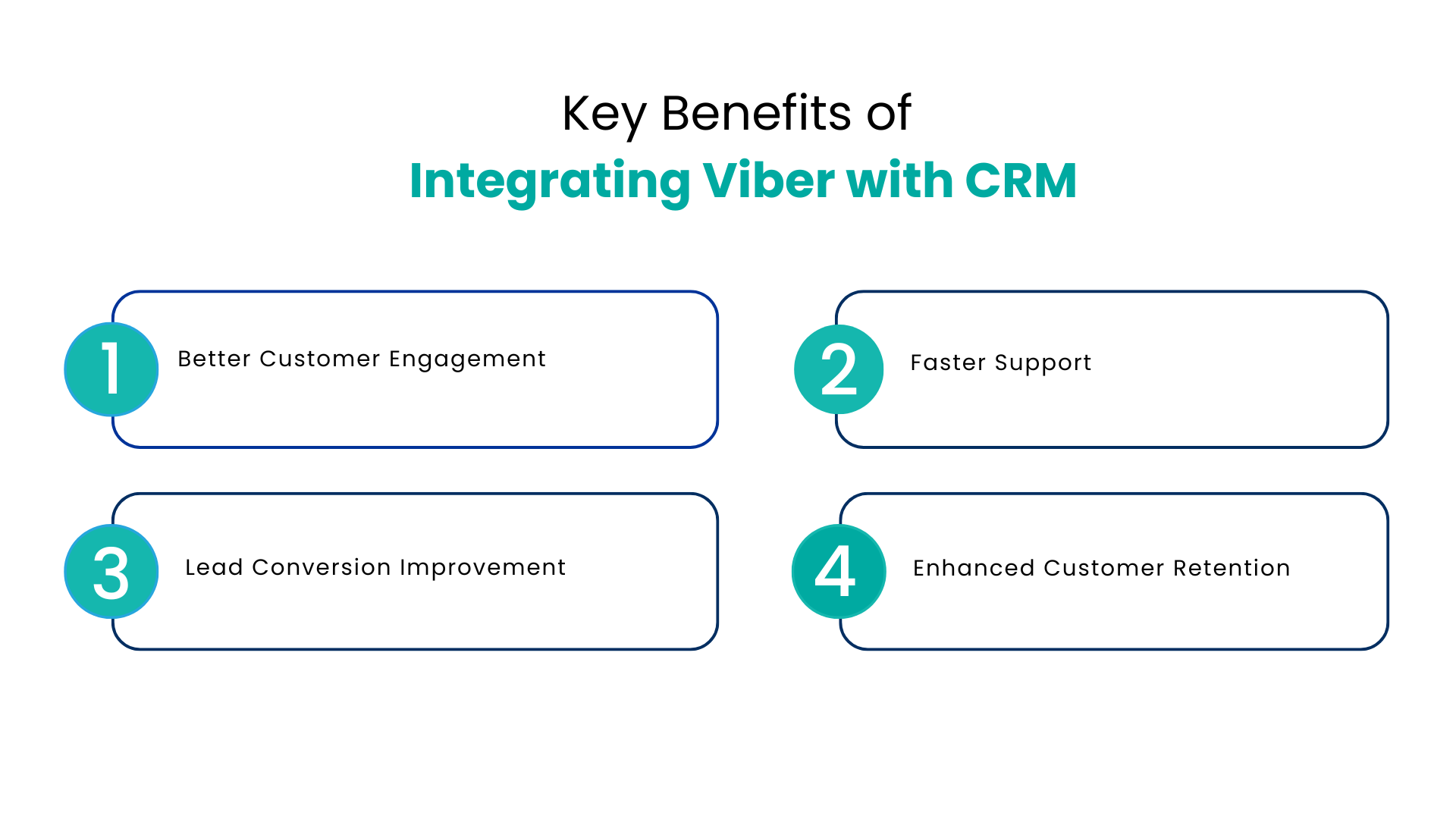
Better Customer Engagement
The Viber platform is a widely used messaging platform across numerous markets in Europe, the Middle East, and Southeast Asia. As far as businesses join their customers on their turf, engagement levels grow. The messages that are sent via the Viber application tend to enjoy a higher rate of opening and responding than those sent through email.
Faster Support
Support agents working with Viber chats directly within the CRM have access to information about the customer’s previous orders, the list of their tickets opened before, and contact information. It significantly cuts down the time needed to solve issues and eliminate unnecessary transfers of customers to other support teams. The result of such a fast solution is reflected in the scores of satisfactions and loyalty.
Lead Conversion Improvement
With sales reps able to interact with prospects in real-time on a platform they are active in, there are numerous factors that help accelerate lead conversion. Customized communications, immediate responses to queries about the product, as well as follow-ups are among such factors. Moreover, the fact that conversations are analyzed and scored within the CRM helps prioritize potential clients.
Enhanced Customer Retention
Keeping customers requires consistent, meaningful communication long after the initial sale. Businesses can use Viber through their CRM to send:
- Product updates and new feature announcements
- Loyalty rewards and exclusive offers
- Renewal reminders and subscription alerts
- Proactive support messages before issues escalate
These touchpoints maintain the relationship without requiring customers to initiate contact.
How Salesforce and Viber Integration Supports Business Growth
Salesforce is one of the most widely used CRM platforms globally, and adding Viber as a native communication channel extends its capabilities significantly. Teams working within Salesforce can send and receive Viber messages without leaving the platform, keeping workflows intact and data clean.
Viber Salesforce CRM integration enables features like automated message triggers tied to Salesforce records, campaign management across messaging channels, AI-assisted response suggestions, and consolidated reporting on message performance. All of this feeds back into Salesforce’s existing reporting and analytics infrastructure, giving managers a fuller picture of customer engagement across the funnel.
Platforms like Communicat-O are purpose-built to make this integration work out of the box. Their Salesforce Viber integration connects both platforms natively, enabling teams to manage conversations, automate workflows, and track every interaction directly within Salesforce.
Best Practices for Building a Multichannel CRM Strategy
A multichannel CRM with Viber works best when it is part of a broader communication strategy rather than a standalone addition. A few practices that make it more effective:
- Integrate your communications on one unified platform. Your entire sales or customer service team will get the full picture of your customer without any context loss when they receive information through Viber, WhatsApp, e-mail and SMS to the same CRM system.
- Communicate with customers in accordance with their journey. Use Viber for the cases where the urgency and personal approach is required and e-mail for long communication. Define the role of each channel.
- Implement automation carefully. Automated messages must always be relevant and timely. Make sure that there are only important triggers for sending messages.
- Get your team up to speed. How valuable Viber integrated into CRM can become depends only on how consistently your team uses it.
- Monitor your performance and improve your strategy. Track statistics on response rate, resolution rate and conversion rate for each channel.
Common Issues and Potential Solutions for Business Organizations
It is easy to integrate Viber messages into a CRM system; however, there are cases when issues might occur during implementation of Viber messages. The most common problems include the following:
- Information silos: When teams utilize multiple solutions that are incompatible with the CRM and add Viber messaging without streamlining solutions, it may generate more noise than desired. Therefore, review all existing tools and streamline them first.
- Managing the number of incoming messages: After implementing Viber, the number of incoming messages may increase significantly. To cope with the situation, implement automated routing of the message to avoid manual overload.
- Compliance: In some industries, business messaging requires a special approach since it involves dealing with sensitive information. In such instances, working with an enterprise-grade solution minimizes risks.
- Resistance to change: There may be instances when teams refuse to utilize a new tool to manage communication with customers and partners. To overcome this issue, demonstrate how beneficial it is from the practical perspective.
The Future of Conversational Commerce and CRM Integration
In terms of engaging with customers, the trend is to have more engagement via more communication channels, greater personalization, and more in real-time. As reported by Salesforce, consumers currently expect firms to know what they want and not treat them merely as contacts in the firm’s database.
Conversational commerce is increasingly becoming the medium by which firms are meeting these expectations. With advances in AI technologies in CRMs, firms will have the ability to predict what the consumer wants, automate the more complex engagements, and hyper-personalize conversations through messaging apps.
Considering the growing market size for Viber and the trend toward messaging-based CRMs, it is highly likely that Viber CRM platform capabilities will continue to increase in the future.
Conclusion
Consumers are always looking for fast, direct, and seamless interactions. With Viber CRM solution, this is exactly what you are getting since it is a way of combining consumer’s preferred interaction channel with a robust CRM solution. Whatever industry you are working in, Viber CRM provides you with everything you need for effective customer engagement throughout the entire customer journey.
FAQs
What is a Viber CRM integration?
It is an integration of the Viber business messaging application and a CRM solution that enables enterprises to conduct messaging on Viber directly from the CRM application.
How does Viber CRM integration work?
It involves synchronization of Viber messages and customers’ CRM profiles so that when a customer messages an enterprise, it shows up in the CRM profile of that customer where the enterprise’s team members can respond to it. The interaction becomes easier for the team because no additional software needs to be used.
What are the main benefits of Viber CRM integration?
The main advantages include increased customer engagement, quick resolution of issues raised by customers, effective conversion of leads into clients, enhanced customer retention rate, and improved data integrity of customer interactions.
Is Viber Salesforce CRM integration appropriate for large corporations?
Yes. Salesforce Viber integration is scalable and allows features such as automation, AI-enabled messaging, bulk marketing, and secure data management, making it perfect for corporate employees with large client bases in several regions.
What distinguishes conversational commerce from other customer communications?
Traditional methods are typically one-sided. For example, sending emails or creating online forms. However, conversational commerce utilizes two-way messaging to interact with consumers during critical times in their purchase process.
For more insights, updates, and expert tips, follow us on LinkedIn.