


Most small and mid-sized businesses are not losing deals because their product is weak. They are losing because their follow-up is slow, their leads fall through the cracks, and their sales reps spend too much time on tasks a computer could handle in seconds.
That is the core problem that AI CRM for SMB solves. And the companies that figure this out first are pulling ahead fast.
This article breaks down exactly what the best-performing SMB sales teams automate, in what order, and why those specific choices lead to more revenue. If you are evaluating CRM platforms, including Salesforce SMB options or newer AI-powered alternatives, this guide gives you a practical framework to make a smarter decision.
Reasons Why Automation Became a Must for Modern SMB Sales Teams
A few years back, automation was something “nice to have” in the world of small businesses. However, today, it has become something of a necessity.
As per U.S. Small Business Administration, SMBs that use digital tools have revenue growth that is nearly twice compared to other SMBs who are lagging in adopting such solutions. In addition, consumers now demand rapid responses, personalized engagement, and constant communication across channels.
Sales professionals in growing SMBs find themselves overloaded with multiple tasks. These include handling inquiries, following up on leads, managing customer queries, updating records, and other activities. This means that some activities are likely to be left behind when performed manually.
Automation does not replace salespeople. It removes the repetitive work so they can focus on closing deals and building relationships. The businesses that understand this are the ones growing fastest right now.
What Top Performing Sales Teams Automate First?
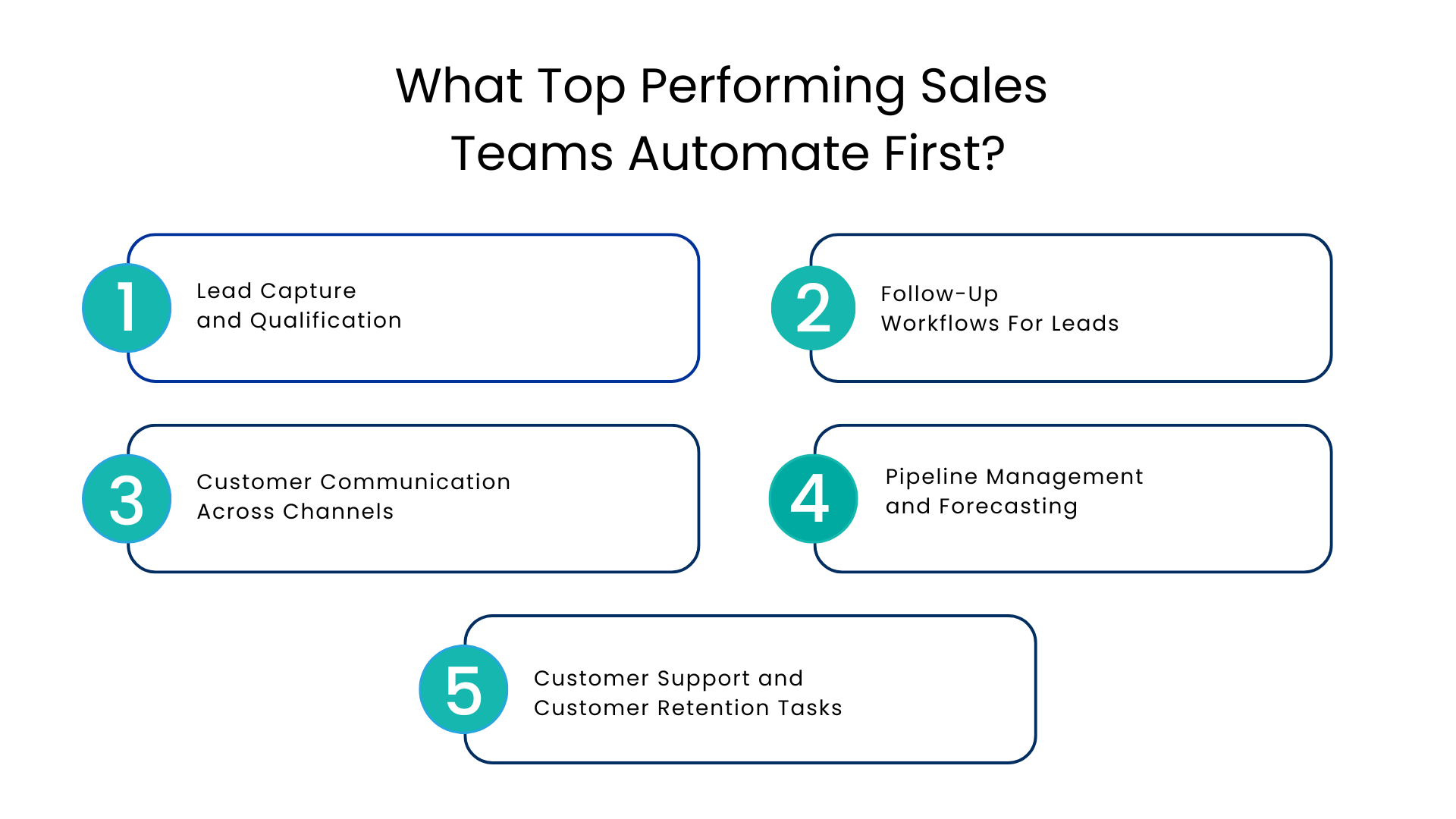
Not all automation delivers the same return. The best teams are selective. They start with the highest-impact workflows and build from there. Here is what they prioritize.
Lead Capture and Qualification
The first-place money is lost in the funnel is at the very beginning. Form submissions, traffic visiting important pages on your site, even social messages all start to accumulate, yet without automation, much of this information will be either overlooked or not acted upon for days.
Top companies have an automated system for capturing their leads, pulling in data from anywhere like web forms, Facebook ads, Instagram Direct Messages, or WhatsApp messages and putting them into one place, then utilizing AI tools to score each potential customer by fit and behavior, so reps know where to begin dialing.
The consequence is that the process becomes quicker and simpler. Leads ready to buy will automatically get pushed into a queue and be followed up promptly by the rep. Leads needing more nurturing will receive a sequence of pre-programmed automated emails.
Follow-Up Workflows for Leads
The importance of speed cannot be overstressed. According to research by the Harvard Business Review, organizations responding to a lead within an hour were six and a half times more likely to qualify the lead as compared to those responding even an hour later. Most SMBs fall far short of this mark in manual follow-ups.
Using automation makes all the difference. As soon as a lead is acquired, a message is sent immediately rather than waiting for hours. In case there is no response, a second attempt is made through a different channel. The entire process operates in the background and requires no supervision daily.
It isn’t about being mechanical here either. Every message can be tailored, addressing the name of the prospect, their product interest or questions asked.
Customer Communication Across Channels
Consumers these days are not confined to any one channel. A person could contact you through your Instagram channel, then drop an email with a query, and then give a call to your customer service team. All this while, if your team is using separate inboxes for each of these channels, confusion arises.
Top performing small businesses have a fully integrated omnichannel communication platform. The emails, texts, calls, and even chats are integrated into a single inbox. Customer representatives and even AI-powered bots can handle all replies from the same place with all past communications.
This may seem like an extra convenience tool, but it does influence customer behavior. When consumers receive prompt replies and feel listened to, no matter what channel they use, they become more inclined to convert.
Pipeline Management and Forecasting
Manually updating deal stages in a CRM is one of the most common time drains in a sales team. Reps either skip it, meaning leadership has no accurate view of the pipeline, or they spend valuable time on data entry instead of selling.
With AI-powered pipeline management, deal stages update based on actual activity. When an email is sent, a call is logged, or a contract is opened, the system updates itself. Sales forecasting tools then use that real-time data to generate accurate revenue predictions, flag deals at risk, and surface which opportunities need attention now.
Teams that automate pipeline management spend less time in status update meetings and more time actually moving deals forward.
Customer Support and Customer Retention Tasks
While most small and medium businesses tend to focus solely on automation during the sales process, some of their highest financial benefits occur after the sale. Retaining an existing client is much cheaper compared to obtaining a new one, and automated tasks help streamline this process greatly.
Some examples of such tasks include automated onboarding for newly acquired clients, proactive follow-ups based on activity, automatic renewals reminders, and automated chats powered by artificial intelligence, which can help address routine queries without any assistance from a person.
How AI CRM for SMB Helps Teams Scale Faster?
Automation is not just about efficiency. It is about giving a small team the ability to do what a much larger team does, without the headcount costs. Here is how that plays out in practice.
Reducing Manual Work
The average sales rep spends roughly a third of their week on tasks that are not actually selling: logging calls, updating records, sending routine follow-ups, scheduling meetings. An AI-powered CRM handles most of that automatically, freeing reps to focus on the conversations that actually move deals.
For a team of five reps, that can translate to the equivalent of two extra full-time salespeople worth of productive selling time, without hiring anyone new.
Improving Response Times
Speed is a competitive advantage that is easy to underestimate. When two companies sell similar products and one responds in minutes while the other takes hours, the faster one wins, even if the slower one has a better product.
AI-driven automation provides a system where each lead and each support ticket get an instant answer that relates directly to their query, even at two o’clock in the morning on a Sunday. The conversational AI will ask initial queries, qualify the intention, and route to the correct person if need be.
Conversion Rate Improvement
Improved lead scoring, follow-ups, and better communication practices contribute to an increased conversion rate. When lead nurturing is done with the appropriate content at the right time and through the right channel, the chance of closing a deal increases significantly.
Customer engagement automation users benefit from reduced sales cycle lengths and increase average deal sizes, mainly due to active lead nurturing and follow-up processes.
Best Practices for Implementing AI CRM for SMBs
Implementing automation goes beyond purchasing a software solution. Some tips that will help SMBs implement their artificial intelligence CRM systems include:
- Prioritize the automatic follow-up of leads first – It will show results faster. Configure the AI tool to send automatic emails to all new leads before doing any other configuration.
- Define your sales process before setting up any automation feature – An automated system will enhance an already existing flawed sales process and make it even worse. Identify all your actions and automate those that don’t need human input.
- Automate communication in a human way – The automation process must be personalized, i.e., use the contact’s name, address previous interactions, and use a conversational language in the message.
- Track the performance of the pipeline weekly – While AI tools offer great forecasting capabilities, such a feature can only prove useful if your CRM system is consistently utilized by your team members.
Conclusion
The gap between the fastest-growing SMBs and the ones that are stuck is not a product gap. It is an execution gap. And execution at scale requires automation built into how you sell, how you follow up, and how you support customers every day.
AI CRM for SMB gives small and mid-sized teams the tools to respond faster, qualify leads smarter, communicate across every channel, and keep customers coming back, without needing a large team to do it manually.
Whether you are evaluating Salesforce SMB solutions or exploring more agile platforms, the question to ask is not which CRM has the most features. It is which platform helps your team execute the highest-impact automations with the least friction. That is the one that will grow your revenue.
FAQs
What is AI CRM for SMBs and why is it different from traditional CRM?
A traditional CRM stores information about contacts and follows up with deals. An AI CRM for SMBs includes all that but also uses artificial intelligence technology to score prospects, do follow-ups, estimate which deals to close, and communicate with clients across multiple touchpoints independently of human involvement. The crucial difference between AI and traditional CRM lies in the fact that AI actively supports selling.
Can we recommend Salesforce as a CRM for SMBs?
The functionalities of Salesforce for small businesses are very strong. However, this platform has many complicated aspects making it hard to work with. Moreover, it requires considerable effort to implement this system properly. Therefore, it is a good solution for enterprises with experienced administrators and more complex requirements.
Which automation should SMBs prioritize in their CRM?
The first thing that brings a significant advantage is automating lead follow-up. It means that you need to provide automated responses to new leads right after receiving them (preferably within minutes). This step directly increases sales performance.
What role does omnichannel CRM play in closing deals for SMBs?
Omni-channel CRM collects all the interactions through email, SMS, WhatsApp, social media, and live chat in one place. As a result, your team is constantly aware of the entire context of each interaction. Quicker and more consistent communication across any channel leads to higher buyer trust and reduces friction which kills deals between interactions.
How quickly do companies start seeing ROI from CRM automation?
It usually takes about 30-60 days for an average SMB to start receiving tangible benefits from automation through lead response times and follow-ups optimization. The deep benefits such as increased conversion rate and enhanced accuracy of forecasts emerge over three to six months of collecting the necessary data and forming a habit of working with CRM.
What distinguishes AI CRM from the Salesforce Marketing Cloud SMB product line?
Salesforce Marketing Cloud SMB mostly relies on email marketing automation, audience segmentation, and campaign management tools. On the contrary, AI CRM platforms unite sales pipeline management, lead scoring, conversational intelligence, and omnichannel communication in one workflow. It gives additional value to those who need more automation in sales and customer support than just emails.
For more insights, updates, and expert tips, follow us on LinkedIn.