


Managing customer relationships across international markets is harder than most enterprise teams expect when they start expanding. Different time zones, different languages, and different communication habits all create friction. But the biggest operational gap is often the simplest one: your customers in the global markets are on WeChat, and your CRM has no idea.
WeChat integration for enterprises closes that gap. With over 1.3 billion monthly active users, WeChat is the primary channel for customer communication, commerce, and support across China and much of Southeast Asia. For enterprises doing business in those markets, it is not a secondary channel. It is the default.
This article explains how integrating WeChat into your enterprise communication stack improves cross-border customer relationships, what the operational benefits look like in practice, and how to implement it in a way that actually scales.
Why Cross-Border Customer Relationships Are More Complex Than Ever?
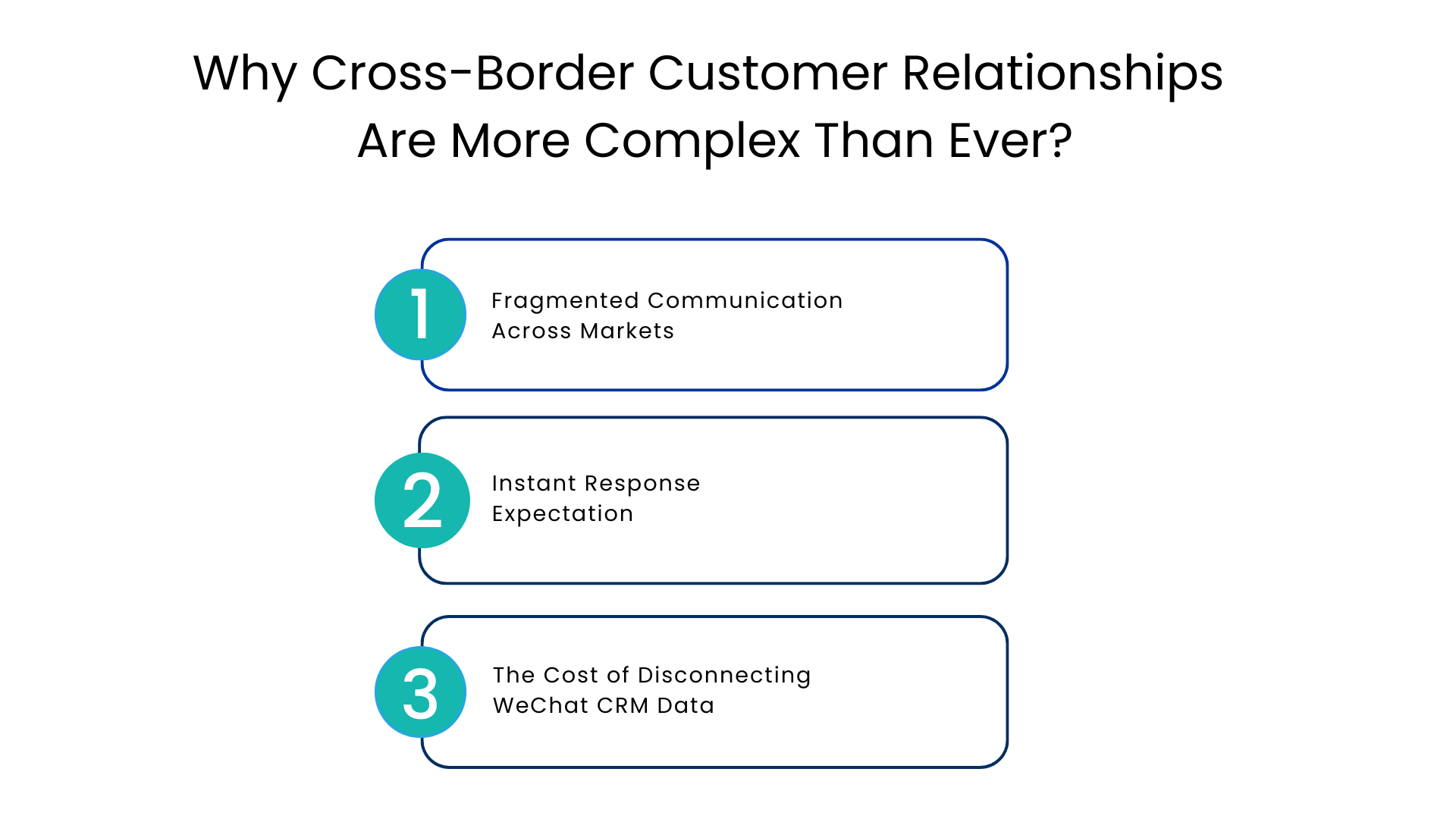
Fragmented Communication Across Markets
The majority of enterprise communication tools operate under assumptions that hold true in Western markets. Email, telephony, and live chats function as expected. However, WeChat is not included in the equation. As a result, interactions in the global market occur on an entirely different platform, or even on a personal device of the agent without any CRM context attached.
Your customer reaches out to your support team via WeChat, then writes an email to your sales team, you will end up dealing with two separate contacts with no information shared between them. Your customer does most of the talking.
Instant Response Expectation
Consumers expect a prompt response via WeChat in just a few minutes. This level of responsiveness was established by local companies, and foreign enterprises operating there need to match it to satisfy customers. The responsiveness of foreign businesses in the target market is one of the primary indicators that determines their success in the eyes of potential clients, according to US International Trade Administration research.
Failure to integrate automated messaging routes into your CRM system can make fulfilling this expectation quite difficult.
The Cost of Disconnecting WeChat CRM Data
When you have WeChat data disconnected from your CRM, there is so much about the customer journey that will be unknown to you. You don’t know what the person bought. You don’t know their previous complaints. You cannot segment them by their activity on WeChat. In cross-border environments where trust-building is an additional challenge, lack of data only makes things harder.
How WeChat Integration for Enterprises Creates a Unified Customer Experience?
Centralizing Customer Conversations
The most immediate benefit of WeChat integration for enterprises is a unified inbox. All WeChat messages flow into the same workspace alongside email, SMS, WhatsApp, and other channels. Agents stop switching between tools. Every conversation stays on record, and distributed teams can pick up context without manual handoffs.
Connecting Messaging and CRM Data
A WeChat message on its own tells you very little. The same message attached to a CRM contact record tells you everything: who this person is, what they have purchased, what issues they have raised, and where they are in the customer lifecycle.
Proper WeChat CRM integration matches every incoming message to an existing contact or creates a new one automatically. Agents see full history before they type a single word in response.
Creating a Single Customer View
When WeChat feeds into the same customer profile as every other channel, enterprises gain a complete view of how global market customers engage across the entire journey. That unified view enables better segmentation, more relevant outreach, and a real foundation for customer retention strategy at scale.
Primary Benefits of WeChat API Integration for Global Businesses
Rapid Response to Customer Queries
The integration allows for automated routing of messages. Messages on WeChat will be delivered to the appropriate team or individual within just a few seconds depending on language, location, or nature of the query. Responses will be automated via artificial intelligence for simple queries with human intervention for complex ones. The response times that used to take hours can now be achieved within minutes.
Better Retention Rate
Customers who get fast and consistent responses from the business will tend to remain loyal clients. In many cases, it can make all the difference in retaining the customer who might decide to shift to other local businesses due to the better service offered. With WeChat Integration, global business gets an opportunity to level up.
Workflow Automation
Integration with WeChat API allows for workflow automation as well. Events such as order confirmation, appointment reminder, renewals, and even post interaction surveys could be set to happen automatically. This helps save time for team members and ensure timely interaction with customers.
The Role of WeChat CRM Integration in Cross-Border Customer Engagement
Why Is CRM Visibility Important?
In international sales, there are numerous parties involved, and deal timelines tend to be extensive. Without CRM visibility into WeChat messaging channels, a large part of the interaction history goes unseen. No coaching can be done properly. No preparation for renewals will be achieved. No indicators of churn can be identified by the customer success team.
Salesforce WeChat integration ensures that WeChat messaging channels are treated as a first-class channel inside the CRM, rather than a separate communication solution outside the scope of the CRM system.
How Can Salesforce WeChat Integration Improve Customer Context?
For companies that use Salesforce as their official CRM solution, Salesforce WeChat integration via an app like Communicat-O allows all the WeChat conversations to be displayed right inside the Salesforce record. The agent will have access to the entire message conversation along with the contact information and previous interactions.
It is especially crucial for teams of agents who work with the same customer from different geographical locations.
HubSpot WeChat Integration and Marketing Alignment
For marketing and sales teams using HubSpot, HubSpot WeChat Integration brings WeChat engagement data into contact records and marketing workflows. Marketers can segment based on WeChat behavior and build nurture sequences that include WeChat as a delivery channel alongside email and SMS. This turns WeChat from a siloed support channel into a full participant in the customer journey.
WeChat API Implementation Best Practices
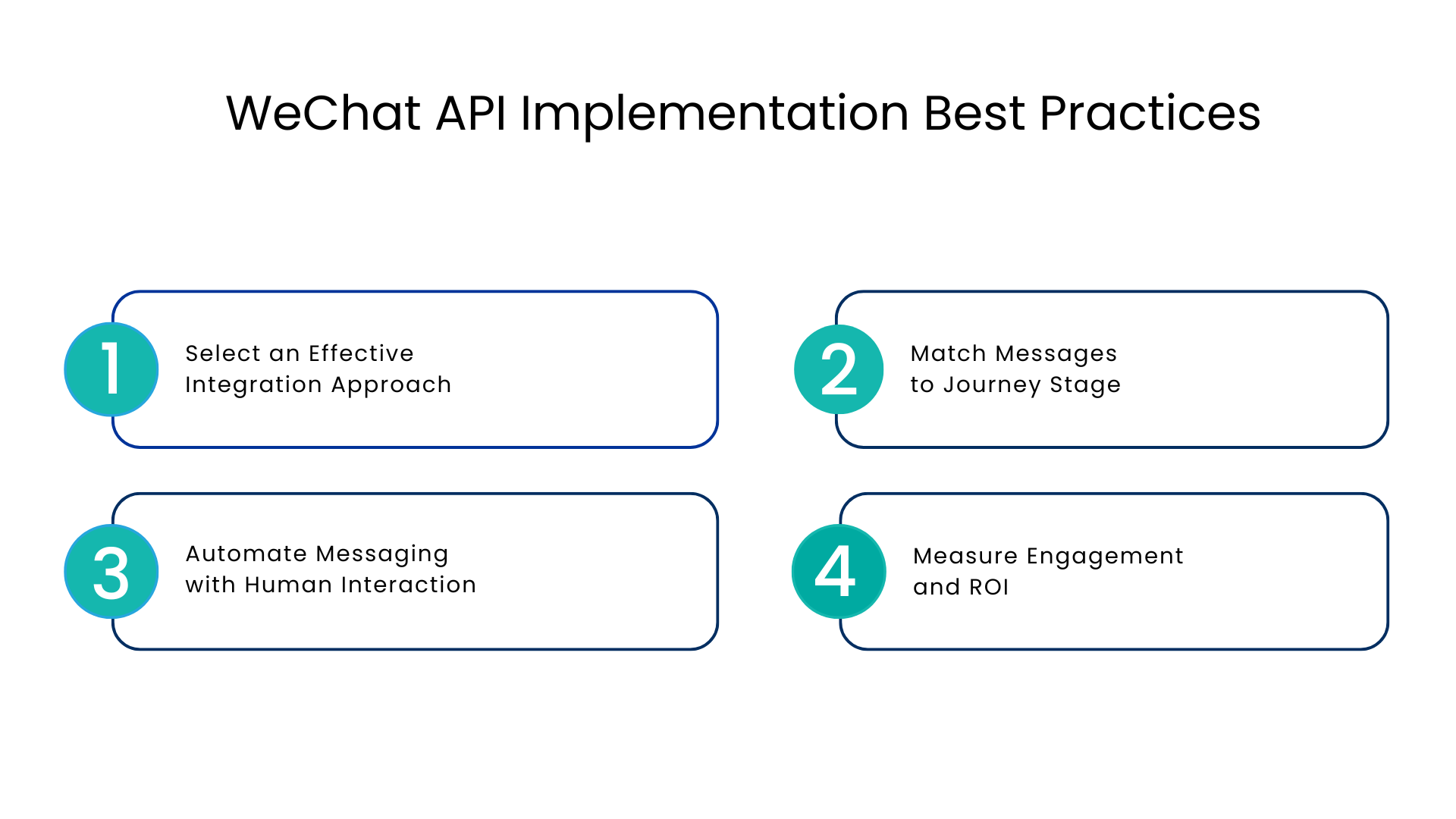
Select an Effective Integration Approach
When comparing platforms, pay attention to how deeply integrated they are with CRM systems rather than just their capability to exchange messages. Simple message synchronization does not offer any real benefits. It is WeChat contacts’ connection with CRM system data about customers’ engagement that brings real results.
Match Messages to Journey Stage
With CRM integration in place, all the relevant information will be available to agents in a few seconds. Use this information to set up workflows for sending messages based on customer journey stages.
Automate Messaging with Human Interaction
While automation can be used successfully for such routine operations as message routing, acknowledgment message sending, FAQ answering, and reminder scheduling, it performs badly when decisions have to be made by people. Automate everything with a clearly defined response.
Measure Engagement and ROI
According to McKinsey’s research on customer experience, companies that measure and act on customer engagement data across channels consistently outperform peers on revenue growth and retention. Define your metrics before going live: response time, first-contact resolution rate, customer satisfaction score, and WeChat-attributed revenue are all trackable once integration is in place.
Future Directions Driving Enterprise WeChat Communications
WeChat communication can soon support complete conversations through conversational AI, which can now respond to messages in Mandarin rather than just script-based exchanges. Businesses have started using their AI-powered chatbots to perform functions such as qualifying leads, answering detailed questions about their products, and responding to straightforward inquiries without the assistance of a representative each time.
Orchestrating the customer’s journey is also evolving. Pioneering organizations have begun developing an omnichannel approach to customer interaction by integrating WeChat into journeys that begin with emails, texts, and voice communications. These interactions seem fluid despite being on different platforms.
Language is no longer becoming a barrier to communication with the advent of multilingual customer service automation. Organizations are thus able to provide their services equally well both to native speakers of Chinese and to English speakers all in one team.
Conclusion
Cross-border customer relationships are built on trust, and trust is built on consistency. When a customer in Shanghai sends a WeChat message and receives a fast, informed, personalized response from a team that knows who they are, that experience creates loyalty. When they wait two days for a generic reply, they look elsewhere.
WeChat integration for enterprises is what makes the first scenario possible at scale. By connecting WeChat to your CRM and customer engagement platform, every team member gets the context and tools to deliver a consistent, relationship-driven experience to every Chinese-market customer.
Communicat-O’s AI-powered customer communication platform brings all channels into one unified workspace. If your enterprise is serious about cross-border customer relationships, exploring what that integration can do for your team is a practical next step.
FAQs
What is WeChat integration for businesses?
WeChat integration connects your WeChat business account to your CRM and messaging systems to ensure that every WeChat chat is recorded and managed. Enterprise teams handle WeChat the same way they do every other channel from their unified workspace to have full access to customer conversations across all channels.
How does WeChat CRM Integration improve customer experience?
WeChat CRM Integration attaches every WeChat chat message to an existing contact within your CRM. Your agents will be able to see a buyer’s purchasing behavior, past interactions with your brand, and their lifecycle phase before responding to them. With this, customers do not need to repeat themselves and receive highly personalized responses.
Is WeChat CRM Integration possible in Salesforce?
Absolutely. There’s WeChat Salesforce Integration through customer communication platforms like Communicat-O. You have WeChat messages right in Salesforce records. Agents can reply and send messages through WeChat directly from Salesforce. Conversation history is always captured in real-time against the correct contact or company profile.
What are the critical advantages of using WeChat API Integration for international companies?
WeChat API integration helps achieve automatic message distribution, fast response time, chatbot support, and CRM sync. With the integration, WeChat will not be an isolated channel that your company handles separately; it will be incorporated within the customer engagement process. The processing time will go down, there will be no need to handle everything manually, and all data gathered via WeChat channels will go into the same database where information about customers from all other countries is kept.
Why is WeChat good for supporting cross-border communication between customers and companies?
WeChat is a leading messaging app with over 1.3 billion active users, mostly living in China and across the world communicating in the Chinese language. For many international firms, it is the single channel through which Chinese clients wish to communicate. The integration of this tool within the company’s communication processes will mean providing support to global market clients on the channel they prefer at par with other regions.
For more insights, updates, and expert tips, follow us on LinkedIn.