

Salespeople in the current environment are being buried under repetitive work. Following each call with a customer, they have to make manual entries, access CRMs, check account histories, and schedule follow-ups. According to statistics from the industry, salespeople waste about one-third of their time doing paperwork.
This is the problem that modern CTI solutions for Salesforce are built to solve. Computer telephony integration has existed for decades, but the latest generation of AI-powered platforms has transformed it from a basic click-to-call utility into a genuine productivity engine. For contact centers, sales teams, and customer support operations, the difference is significant.
The Evolution of CTI Solutions in Salesforce
From Basic Telephony to Intelligent Calling
With the evolution of the Salesforce platform, there were higher expectations associated with telephony integration capabilities. The development of Salesforce Open CTI integration provided a common ground for embedding calling controls in the Salesforce application itself, eliminating the need to utilize separate software. It was an important advancement for customer service agents; however, intelligence behind such processes was still managed manually.
Times have changed. Businesses now have other communication needs. Customers require fast responses tailored specifically to their needs. Sales managers need to have full visibility into activities in the sales pipeline. Customer support directors need to understand why calls go from bad to worse, and how to avoid that.
Why Organizations Need to Step Up from Standard CTI
Organizations are being forced to switch to artificial intelligence-based CTI systems due to the limitations of the conventional methods. The following are what conventional CTI systems cannot accomplish effectively:
- Automated recording of the result of a call or conversations
- Provision of relevant details about the customers during active calls
- Insights regarding calls prioritization and routing
- Ineffective manual notes taking by agents
- Data segregation between telephony systems and CRM processes
AI-driven Salesforce CRM CTI integration addresses each of these gaps by embedding intelligent automation directly into the agent’s daily workflow.
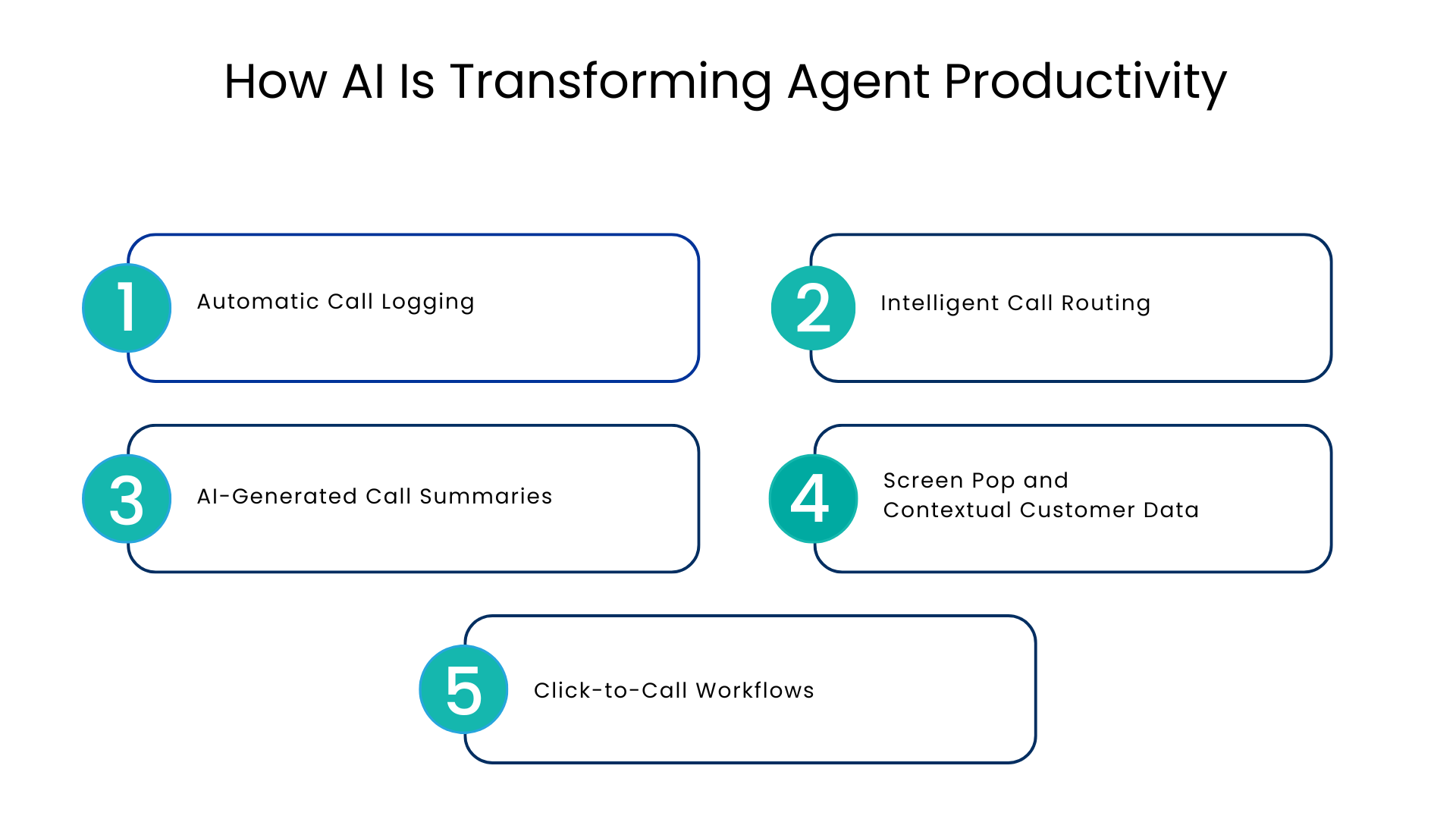
How AI Is Transforming Agent Productivity
Automatic Call Logging
Here lies the area where one can expect rapid and tangible improvement in productivity. With the help of an AI-driven CTI solution, all calls get logged automatically into the correct Salesforce account. Duration, timestamp, call results, and a summary are added to the CRM instantaneously upon the call end.
The time saved from having to spend five to ten minutes writing notes for each call can accumulate rather quickly with twenty agents processing fifty calls a day. Moreover, thanks to automated data entry, data accuracy gets much better as any possible human errors are eliminated at once.
Intelligent Call Routing
All calls are not created equal; therefore, efficient call routing is a must-have feature for businesses seeking success. Using AI-powered intelligent call routing, a range of factors such as the caller’s previous history, signs of interest, language preferences, and queue load can be analyzed in order to find the ideal recipient.
In the case of sales calls, this means that calls containing leads with purchase intention will be prioritized and forwarded to top-tier closers. In regard to support calls, calls with repeat customers will be routed to agents who have all the necessary context ready.
AI-Generated Call Summaries
Following a customer discussion, an AI tool is capable of providing a detailed summary that includes topics covered, tasks to do, and indicators of mood. The summary will automatically be synced with the record on Salesforce and will become part of the customer’s history.
This process is equally valuable for sales managers. They no longer have to listen to audio recordings of calls in order to find patterns, objections, or lost opportunities.
Screen Pop and Contextual Customer Data
One of the most valued features in any CTI-enabled Salesforce CRM is the screen pop. When an inbound call arrives, the agent’s Salesforce screen automatically loads the caller’s account, recent interactions, open cases, and purchase history before they answer.
The result is that agents start every call with context instead of spending the first minute asking for information the customer has already provided. This single feature significantly improves both agent efficiency and customer experience.
Click-to-Call Workflows
Increased efficiency applies to outbound activities as well. One is able to make outbound calls simply by clicking on the Salesforce record or list view at hand. By integrating call logging capabilities, one is assured of closing a loop where you click to place a call, discuss the matter, and then go back to an updated CRM.
Power dialers extend this process by automatically calling contacts from a prioritized list so that agents remain actively involved in discussions.
Key Features Businesses Should Look For
When evaluating CTI solutions for Salesforce, prioritize platforms that offer:
- Salesforce Native Open CTI for better functionality without cumbersome third-party connectors
- Screen pops that relate to records within the CRM, not only phone numbers
- Automated call summaries along with automatic note updates
- Advanced call routing with customizable priority settings
- Click-to-call feature along with power dialing feature
- Omni-channel communication capabilities to ensure voice communication is integrated with all other channels like email, messaging, and chat
- Analytics and reporting tools that measure call success metrics along with agent performance metrics
- Workflows that can initiate tasks or emails depending on the outcome of a call
- Mobility solutions to ensure remote employees have the ability to communicate effectively
The inclusion of voice as part of Salesforce communication capabilities means that voice is an integrated communication solution instead of being siloed.
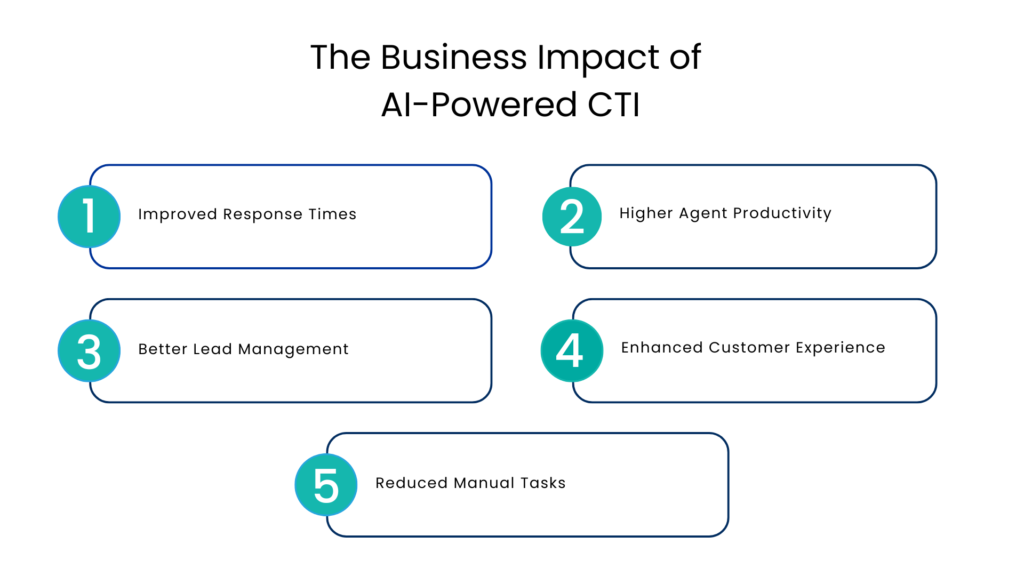
The Business Impact of AI-Powered CTI
Improved Response Times
By offering context instantly through screen pop and routing calls automatically to the appropriate agent, customers will be on hold for shorter periods of time without having to repeat their stories.
Higher Agent Productivity
Reducing the manual tasks done after a call allows agents to do productive sales/service-related tasks. Companies using smart dialer technology for making calls in Salesforce usually show decreased after-call time within weeks.
Better Lead Management
Each new inquiry registered, documented, and tied to the appropriate Salesforce object will result in a comprehensive account of lead interactions. The sales manager will know which leads were followed up with, what was communicated, and what follow-up action is required without needing to question any particular sales agent.
Enhanced Customer Experience
The customer will feel the difference if the agent is familiar with their profile information. Thanks to screen pop and AI-generated summaries of previous calls, each call with an agent is handled efficiently and effectively from the start.
Reduced Manual Tasks
Automation rules tied to call results lower the burden of CRM management. If the call results are “demo scheduled,” an invitation will be generated in the calendar, the deal stage will be updated, and the client will receive a notification automatically.
Challenges and Best Practices
Common Implementation Pitfalls
- Implementing CTI without aligning with the current Salesforce processes and creating duplicate records
- Not training agents to use screen pop and AI summarization capabilities, thus failing to encourage their usage
- Selecting solutions that do not have native Open CTI functionality, thus adding to the maintenance burden
Adoption Difficulties
Resistance to change is expected. Those used to manually enter information might find AI summaries hard to trust. The solution is to conduct a pilot project involving volunteers who will then convince others of its usefulness through personal experience.
Optimization Strategies
- Ensure the call disposition codes are audited before implementing so that the AI categorization works perfectly with your sales stage
- Regularly examine AI summaries in the first few months of implementation to check for anything that needs adjustment
- Set up performance dashboards as soon as you start implementing to track adoption rates
Future Trends in AI-Powered CTI and Communication
The development of AI-powered insights for CTI takes a direction towards technologies that will look truly disruptive just a few years later.
- Conversational AI and coaching in real-time: AI models which analyze live calls and provide suggestions and reminders about compliance for agents during conversations
- Prediction of call outcome: Technologies predicting chances for customers to respond, interact, and buy something before initiating any call according to behavior
- Voice and emotional intelligence: Sentiment analysis to notify supervisors of the client’s irritability during interaction so that they can help to change the situation
- Omnichannel engagement integration: Agent desktop with all types of contact management in voice, chat, video, and social networks via one connected view in Salesforce
- AI-powered assistance for decision-making: Suggestions about price, cross-selling, and call handling according to customer behavior and interaction in real time
All this demonstrates reasons to develop such technologies now. Companies implementing artificial intelligence in their business processes right now will benefit greatly from that soon.
Conclusion
The era when CTI was just a connection between a phone call and a CRM system is gone. Thanks to the advent of AI-driven CTI solutions for Salesforce, there’s no longer a need for agents to handle tasks like logging, routing, summarizing, and follow-ups manually, giving them time to have productive conversations.
For sales reps, it translates into more phone calls, better lead tracking and data, and shortened sales cycles. For support teams, it allows for quicker resolutions and happier customers. For managers in contact centers, it gives them full visibility and control – something spreadsheets and old systems can’t offer.
It’s high time that organizations using basic phone functionality in their Salesforce implementation start closing the productivity gap that separates them from those using AI.
FAQs
What are CTI solutions for Salesforce and how do they work?
CTI solutions link your phone or telephony cloud platform to Salesforce CRM. On receiving a call or making one, integration performs actions such as popping up relevant screen information, automated logging of calls, and triggering workflows in the Salesforce environment. AI-based CTI provides further levels including intelligent routing, call summary, and predictive analytics among others.
How is the integration with Open CTI from Salesforce different from regular CTI solutions?
Salesforce Open CTI integration uses an API framework provided by Salesforce to integrate third-party telephony providers within the Salesforce CRM environment. It contrasts with traditional adapters which were run using desktop applications. Open CTI integration works entirely within the browser and integrates seamlessly with the CRM.
Does AI-powered CTI help manage leads in Salesforce?
Yes, it does. By integrating with the CRM lead management process, CTI ensures all incoming and outgoing calls are linked automatically to a particular contact or lead. Integrating intelligent call routing and call summaries based on the AI will provide the best history of activities associated with a lead.
What are some of the productivity benefits teams may expect to receive using a Salesforce CRM that utilizes CTI?
One would observe reduced after-call activities, quicker responses owing to screen pops, and first-time call resolutions due to proper routing. These productivity gains are even more pronounced among high-volume operations with a lot of calls on a daily basis.
Is Salesforce CRM CTI beneficial to smaller companies, or is it meant for larger enterprises alone?
Not so, as small companies also benefit greatly by gaining efficiencies through click-to-call, automatic recording, and screen pops without having to build a lot of infrastructure. Larger companies get more out of it through intelligent routing, omnichannel communication unification, artificial intelligence, and supervisor dashboards.
For more insights, updates, and expert tips, follow us on LinkedIn.