

A Facebook Messenger integration turns casual chats into a real sales channel, and AI is what makes those chats convert instead of piling up unread. When Messenger connects directly to your CRM, every question, product inquiry, and follow-up lives in one thread that your sales team can actually act on.
That shift matters because customers already prefer this channel over phone calls and email. Meta-commissioned research through Kantar found that most consumers now favor messaging as their primary way to reach a business, and a similar majority say they trust a brand more when they can message it directly. Businesses that treat Messenger as an afterthought are leaving a large chunk of buying intent unanswered.
Why Messenger Conversations Are Turning Into Real Sales Opportunities
Messenger was built for casual conversation, but that casual tone is exactly why it works for sales. People ask questions they would never bother emailing about, and they expect an answer within minutes, not days.
- Consumers who can message a business are more likely to buy from it, according to the same Kantar research cited above.
- Response speed drives trust. A slow reply on Facebook Messenger CRM reads as disinterest, even if the business is simply short-staffed.
- Conversations start earlier in the buying journey, often before a lead ever fills out a form.
- Messenger threads keep full context, so a customer never has to repeat themselves the way they might switch from chat to email.
This is why more sales and support teams are treating Messenger less like a side channel and more like a primary Facebook CRM messaging surface. The people asking questions there are often further along than a typical form submission suggests.
How AI Helps Qualify and Prioritize Messenger Leads
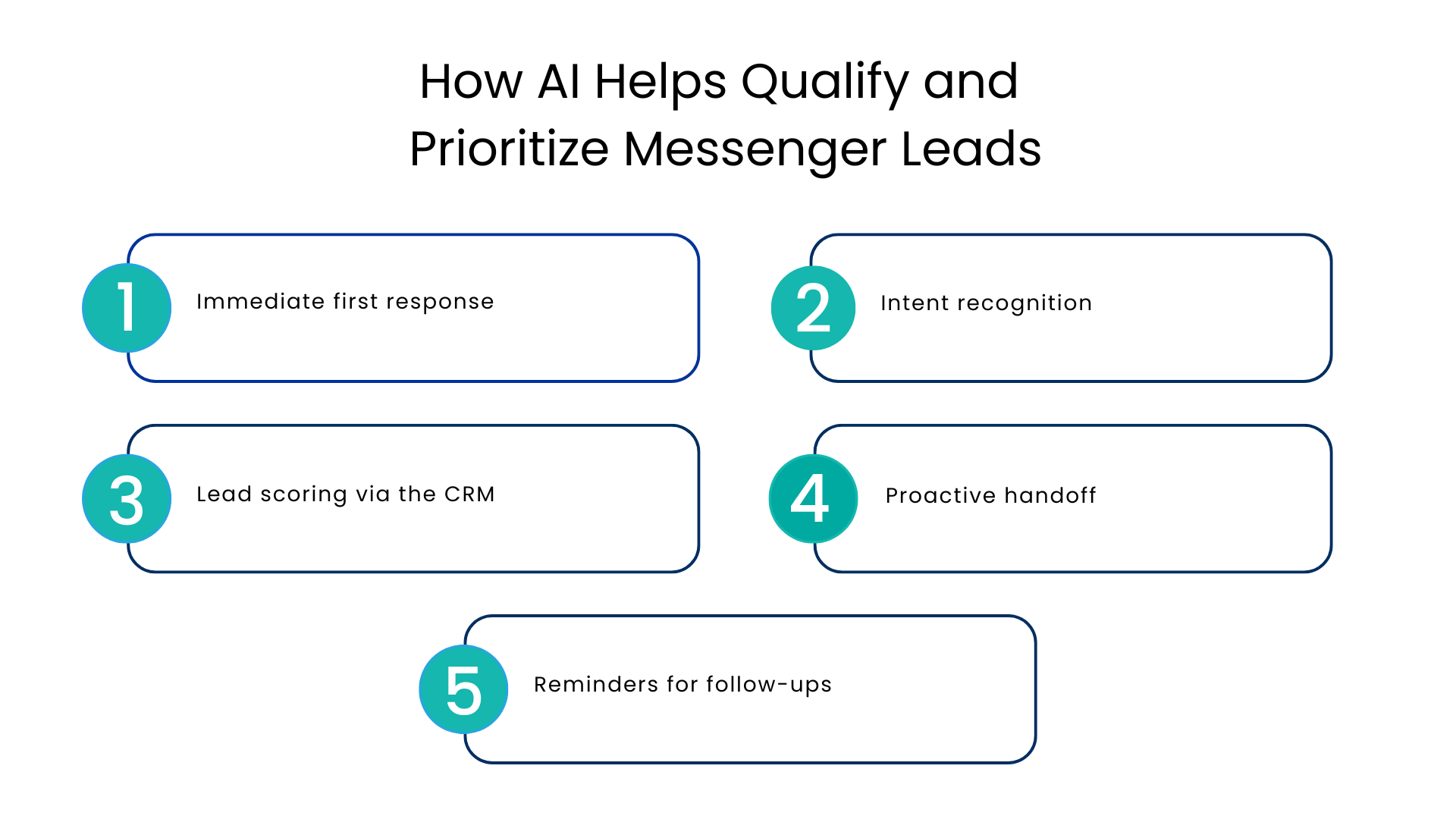
Not every message deserves the same urgency. AI-assisted responses help sort incoming conversations so sales reps spend time on the ones that matter most.
1. Immediate first response: AI instantly answers frequently asked questions, so no lead has to wait while an agent is dealing with another query.
2. Intent recognition: The system recognizes buying intentions such as asking about prices and/or requesting a demo, then routes such leads to a live person.
3. Lead scoring via the CRM: Conversations are directly added to the CRM and can be used for lead scoring instead of just the forms being filled.
4. Proactive handoff: In case a conversation becomes too complicated, AI automatically transfers it to a person who can help, attaching all necessary information.
5. Reminders for follow-ups: The system will mark conversations where customers stopped talking, which helps not lose a potential lead due to lack of reply.
None of this replaces a human conversation. It just makes sure the right conversations reach a person quickly, while routine questions get resolved without anyone waiting.
A Practical Workflow Example
A customer messages a furniture retailer’s Facebook page asking whether a sofa comes in a specific fabric. AI answers instantly using product data already synced from the catalog, confirms the fabric is available, and asks if the customer wants delivery details.
The customer responds with the delivery zip code, which is a clear sign that they are ready to purchase. This interaction gets tagged and passed onto the sales representative, who has all the information of the chat in one place. They close the deal with just one message.
A Lead Qualification Example
An entirely new customer reaches out merely to inquire about store timings. The chatbot responds to this query directly and keeps a record of the chat, but nothing in the entire chat indicates any intention to purchase. No representative is involved, and there is no lead scoring either.
Compare that to a customer who asks about bulk pricing and mentions a project timeline. That combination triggers a higher lead score automatically, and the conversation gets surfaced to a rep within minutes. The difference between these two examples is what separates a channel that generates noise from one that generates revenue.
Managing Messenger Without Leaving Salesforce
For Salesforce users, one of the biggest practical questions is whether Messenger conversations require a separate tool. They do not have to. Salesforce-native messaging setups let a Facebook Messenger integration with Salesforce sync conversations directly into existing lead and contact records, so reps never have to toggle between platforms.
Native integration is very important. Firstly, having a shared inbox allows several people to view the thread of conversations, allocate them to the responsible staff, and prevent the uncomfortable moment when two representatives give different responses to one client. Secondly, all conversations will be logged automatically, and managers will have an insight on the time taken to respond and their results without manual work of saving chats in CRM.
| Approach | Standalone Messenger Chat | Salesforce-Synced Messaging |
| Conversation history | Lives only on Facebook | Logged automatically to the CRM record |
| Lead visibility | Limited to whoever checks the inbox | Visible across the sales team |
| Follow-up tracking | Manual, easy to miss | Built into existing pipeline stages |
| AI-assisted replies | Basic or none | Context-aware, tied to CRM data |
| Reporting | Minimal | Full analytics on response time and conversion |
Teams evaluating a unified messaging platform often find that the real gain is not the chat widget itself. It is having every channel, not just Messenger, feeding the same pipeline instead of scattering conversations across five different apps.
A Simple Checklist Before You Connect Messenger to Your CRM
A few things are worth confirming before turning on a Facebook Messenger integration for lead generation.
- Ensure that your Facebook Page is verified and eligible to use Messenger API.
- Choose what kinds of conversations will be managed by AI and which will go straight to the human team.
- Develop guidelines on how leads will be scored so that their intention moves the conversation forward.
- Ensure that conversation logging corresponds with the appropriate CRM field instead of a generic “activity” note.
- Test the handoff process so that the customer doesn’t have to re-explain themselves after the AI.
- Establish ownership of conversations so that there isn’t one left unattended in the shared inbox.
Skipping any of these steps usually shows up later as slow response times or leads that never make it into the pipeline at all.
Where This Fits Into a Broader Messaging Strategy
Facebook Messenger rarely operates alone. Most businesses running Messenger also manage WhatsApp, Instagram, or SMS conversations, and customers do not think in terms of which app they are using. They just expect a reply.
With multi-channel messaging support, the company has an option to use the same criteria for qualifying and logging into their CRM, regardless of which platform they are using. Consistency in these processes is what differentiates companies who can convert Messenger leads from those who treat each channel as a unique challenge.
Ready to bring Messenger conversations directly into your CRM pipeline? A Salesforce-native messaging setup with built-in AI qualification can turn scattered chats into a tracked, repeatable source of revenue.
FAQs
How Does Facebook Messenger integration with CRM work?
Facebook Messenger integration links your Facebook Page chat inbox with the CRM, thus making sure that the conversations, contacts information and the follow-up activities are captured and documented rather than remaining stuck within the Facebook Chat inbox itself.
Can AI qualify sales leads from Messenger conversations?
Yes, AI evaluates the content of the conversation to find out any purchase intent, such as queries about pricing and timelines and qualifies the lead appropriately.
Does Facebook Messenger CRM integration work with Salesforce?
Yes, native Salesforce tools help integrate the Messenger conversations within existing lead/contact records within Salesforce, thus allowing the salespeople to manage the chats without switching to other platforms.
Is Facebook Messenger a Simple CRM Integration?
The integration process is fairly simple provided that the Facebook Page has been already verified for Messenger API access.
How fast should a business respond to a Messenger lead?
As fast as possible. Consumers increasingly expect messaging to feel as immediate as texting a friend, and slow replies are one of the main reasons warm leads go cold on this channel.
For more insights, updates, and expert tips, follow us on LinkedIn.